










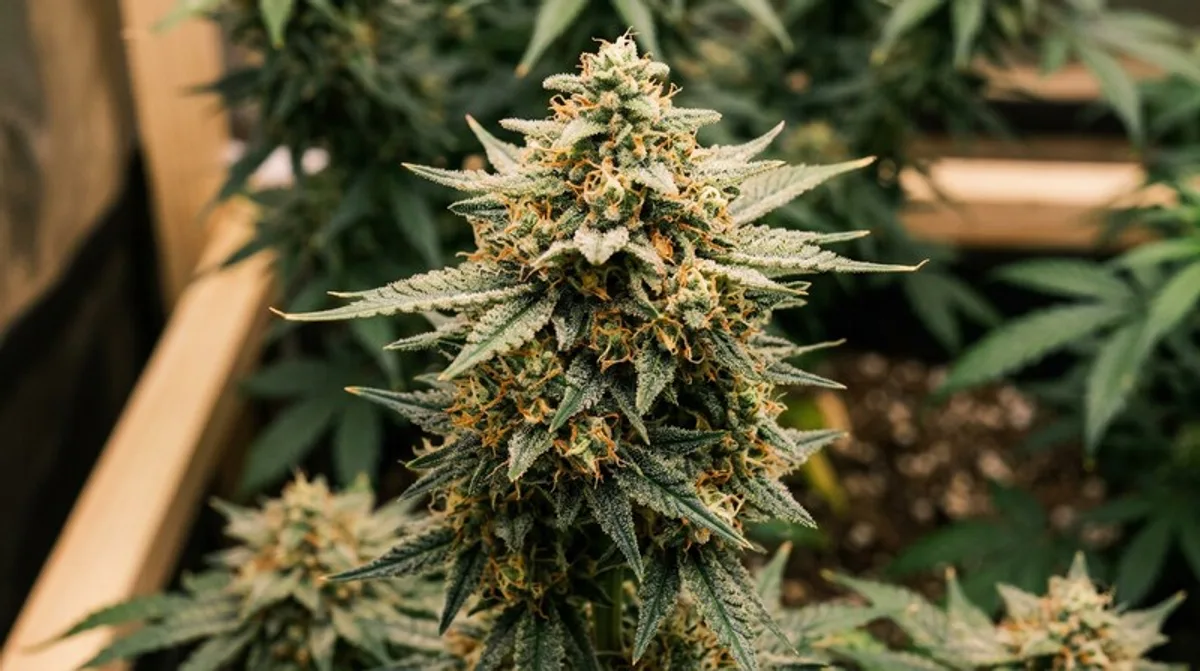
- LST (Low-Stress Training) increases harvest weight by 20–40% versus untrained plants under identical conditions, with zero recovery downtime required.
- Topping and FIMing disrupt auxin flow from the apical meristem, causing 2–4 new equal colas to develop within 7–14 days of a single cut.
- Mainlining creates a symmetrical 8–16 cola structure where every bud site develops to the same size and ripens simultaneously.
- Screen of Green (ScrOG) fills the light footprint completely, enabling canopy efficiencies of 1–2 g per watt in optimised indoor environments.
- Sea of Green (SoG) packs 4–16 plants per m² and cuts the overall grow cycle by 2–4 weeks by triggering flower early on compact, single-cola plants.
- Supercropping crushes the vascular tissue inside a stem without breaking the skin, producing a knuckle callus that permanently strengthens the branch and redirects growth hormones below the bend.
- Autoflowering strains should receive only LST — their compressed veg window leaves no time to recover from any HST before flowering begins.
The Science of Apical Dominance: Why Training Works
Every cannabis training method — from the simplest tie-down to a fully manifolded eight-cola plant — exploits the same biological mechanism: apical dominance. The main growing tip (apex) of an untrained cannabis plant continuously produces the plant hormone auxin, which travels downward through the phloem and chemically suppresses the development of lateral shoots at every node below. The visible result is the classic Christmas-tree silhouette: one dominant central cola surrounded by progressively smaller branches and airy, underdeveloped popcorn buds that waste the plant’s energy and the light above them.
When that apical signal is interrupted — by bending the stem sideways, removing the tip entirely, or crushing the vascular tissue inside the branch — the hormonal suppression lifts. Dormant lateral buds receive the biochemical instruction to grow aggressively and compete to become the new apex. Within 48–72 hours of an effective LST bend, measurable increases in lateral shoot elongation are visible. Within 10–14 days of a clean top, the two new growth tips can already exceed the height of the original cut site. This predictable biological response is the mechanism that makes every technique in this guide work, regardless of whether it involves scissors, wire, or fingers.
Beyond yield, training delivers a critical structural benefit: a managed horizontal canopy dramatically improves airflow through the lower zone of the plant, reducing the relative humidity pockets where mould and mildew thrive. Any grower familiar with the importance of proper drying and curing understands that moisture management begins at the canopy level, weeks before harvest. For growers selecting cannabis strains with training compatibility in mind, indica-dominant genetics tend toward compact, branchy structures well suited to ScrOG, while sativa-dominant and hybrid genetics often produce the long internodes that respond most dramatically to topping and mainlining during extended vegetative periods.
| Technique | Difficulty | Yield Impact | Best For | When to Apply |
|---|---|---|---|---|
| LST (tie-down) | Beginner | +20–40% | All strains incl. autos | Node 3–5, early veg |
| Topping | Intermediate | +30–50% | Photoperiod, vigorous strains | Node 5–6, mid-veg |
| FIMing | Intermediate | +25–45% | Photoperiod, shorter recovery | Compact new tip, mid-veg |
| Mainlining | Advanced | +40–60% | Indoor single-plant setups | Node 3, repeated |
| ScrOG | Intermediate | +50–80% | Indoor, limited vertical space | Before final veg stretch |
| SoG | Intermediate | Cycle efficiency | Clones, uniform genetics | Flip at 15–30 cm height |
| Supercropping | Advanced | +15–30% | Tall, stretchy sativa strains | Late veg, tall branches |
| Defoliation | Intermediate | +10–20% (contested) | Dense canopy in late veg | Max day 21 of flower |
Low-Stress Training (LST): Step-by-Step Tie-Down Method
LST is the entry point for every serious cultivator. It requires no surgical precision, no recovery time, and under five dollars in materials. The entire technique rests on one principle: if you bend a growing tip down and outward until it is horizontal, the lateral shoots below it will accelerate upward and rapidly match or exceed its height. Repeat this process with every new dominant tip and within two to three weeks of vegetative growth you will have a flat, radial canopy where every bud site sits at roughly the same distance from the light source.
The only tools required are soft silicone plant ties (never hard wire), small binder clips or purpose-drilled holes around the pot rim for anchor points, and a pair of scissors. The process begins at node 3–5, when the main stem is young enough to bend without snapping but sturdy enough that the tie holds. Younger tissue responds more readily and heals faster; older, woody stems may crack under pressure if bent too sharply.
- Set anchor points: Attach binder clips or thread low-gauge wire through holes drilled around the pot rim. These become the fixed anchor points for your branch ties throughout the grow.
- Bend the main cola: Gently arc the main stem down and outward toward the pot rim, aiming for 45–80 degrees from vertical. Secure with a soft tie through an anchor point. Do not exceed 90 degrees in a single session — work gradually over 1–2 days if the stem resists.
- Watch for new tops: Within 48–72 hours, the lateral shoots below the bend will begin growing upward aggressively. As each one becomes the tallest point in the canopy, tie it down in turn.
- Check every 2–3 days: Ties loosen as branches expand. Hard or tight ties cut off vascular flow and cause constriction injuries — check and adjust at every training session during periods of rapid vegetative growth.
- Build the radial wheel: The finished LST canopy should resemble spokes on a wheel — branches radiating outward from the pot centre at an even height, with every bud site in the same light zone.
- Combine with light defoliation: In the final days of veg, remove fan leaves that directly block lower bud sites. This maximises the light penetration LST has created without adding significant plant stress.
For autoflowering strains, start LST at day 14–21 from germination and keep adjustments gentle and incremental throughout the life of the plant. The auto’s compressed timeline means there is no recovery window — LST is the only recommended technique. Understanding the germination process and starting LST early in the seedling stage consistently produces the best canopy uniformity at harvest in our grower community feedback.
Topping vs. FIMing: Removing Apical Dominance
Topping and FIMing both remove growing tissue to break apical dominance, but they differ in how much is removed, how many new colas result, and how much stress is imposed on the plant. Both are High-Stress Training methods and both require active vegetative growth with a root system strong enough to support rapid recovery. Neither should be applied during the final two weeks before flipping to flower or at any point during flowering itself.
Topping removes the entire apical meristem — the complete new growth tip — with a clean, precise cut just above a node. The two lateral shoots directly below the cut become the new main colas. These can each be topped again once they develop 2–3 new nodes, doubling the cola count from 2 to 4, then 8, then 16 with each successive round. Recovery takes 7–14 days and is highly predictable. The result is a symmetrical, controllable branching structure.
FIMing — from “F*** I Missed,” coined when a grower accidentally made an imprecise top — removes only 70–80% of the new growth tip while leaving some meristematic tissue intact. The partial removal triggers the development of 3–4 new growth tips instead of 2, giving a higher branching ratio per intervention. Recovery is marginally faster — 5–7 days typically — because less tissue was removed. FIMing is less predictable than topping: exact results depend on how precisely the cut is placed relative to the developing tip tissue.
| Factor | Topping | FIMing |
|---|---|---|
| Tissue removed | 100% of apical tip | 70–80% of apical tip |
| New colas produced | 2 (predictable) | 3–4 (variable) |
| Recovery time | 7–14 days | 5–7 days |
| Stress level | High | Medium–High |
| Predictability | High | Medium |
| Repeatable? | Yes, multiple rounds | Less common to repeat |
| Best paired with | LST, mainlining, ScrOG | LST for canopy spread |
| Autoflower safe? | No | No |
After either technique, the follow-up step is always LST — tying the new multiple colas outward and downward so each developing apex receives direct light. This HST-plus-LST combination is the most widely used high-yield indoor strategy in home cultivation. Growers running hydroponic systems often pair topping with ScrOG because the accelerated growth rate of hydro fills the net faster and the combination consistently produces the highest gram-per-watt ratios available.
Mainlining and Manifolding: The Symmetrical Cola System
Mainlining — also called manifolding — is a structured training programme that builds a perfectly symmetrical plant architecture with an equal number of identical colas, all growing from the same node position and receiving identical hormone and nutrient signals. The technique was popularised in online growing communities in the early 2010s and has since become a standard method for indoor growers who want precise canopy control and maximally uniform harvests. A fully manifolded plant looks nothing like a natural cannabis plant: it is flat, radially symmetrical, and every bud site is at the same height and the same distance from the light.
The process begins by topping the plant at the third node, then removing all growth below the two remaining nodes — a complete clean-up that forces every joule of energy into just two shoots. Those two shoots are each topped again once they develop three nodes, creating four equal branches. One more round produces eight. Most indoor growers stop at eight colas because sixteen or more requires so much additional vegetative time that the gains rarely justify the delay unless the grow space is very large or the light footprint is wide enough to warrant the extra structure.
After the final topping round, LST spreads all branches outward into a flat radial pattern. Because every branch was created at the same node sequence from the same topping sessions, they carry identical developmental history and produce buds of virtually identical size, density, and harvest timing. This eliminates the most frustrating characteristic of less structured grows — top buds ready while lower sites are still weeks away from peak ripeness.
The main trade-off is time. Mainlining adds 3–5 weeks to the vegetative period compared to a simple single-top plant. It is strictly a photoperiod technique. For growers who select appropriate genetics and plan their timeline accordingly, mainlining consistently delivers among the highest gram-per-watt ratios of any single-plant indoor method.
ScrOG and SoG: Filling the Light Footprint
Screen of Green (ScrOG) and Sea of Green (SoG) are both canopy management systems that optimise light use efficiency across the entire grow space — but they approach this goal through fundamentally different means. ScrOG uses a single net to spread and hold multiple branches from a small number of plants, ensuring every cm² of light footprint is covered by a productive bud site. SoG grows many small plants simultaneously and triggers flowering early, turning the whole space into a dense canopy of single-cola plants that finish quickly.
ScrOG: Install a net or trellis 20–40 cm above the pots with 5–10 cm grid squares. As branches grow through the net during veg, tuck them horizontally across the screen toward open squares. The goal is to fill 60–70% of the net before switching to 12/12. During the first two to three weeks of flower (the “stretch”), the remaining squares fill naturally. After the stretch, stop tucking and let the plant grow upward through the screen into the light. The ScrOG method is particularly effective in confined indoor spaces where vertical height is limited but horizontal footprint is generous.
SoG: Pack the grow space with uniform clones or seedlings at 4–16 plants per square metre. Allow just 1–2 weeks of veg until plants are 15–30 cm tall, then switch to 12/12. Each plant produces one dominant cola and finishes 2–4 weeks faster than a full-cycle single-plant grow. SoG is most efficient with clones from a single mother plant because genetic uniformity ensures every plant flowers and finishes simultaneously — mixed genetics produce uneven ripening that eliminates the method’s primary advantage.
Supercropping, Defoliation, and the Evidence Debate
Supercropping involves softening the internal vascular tissue of a branch — without breaking the outer epidermis — so the branch can be bent sharply without snapping. Pinch a section of stem between thumb and fingers and gently roll and squeeze until the inner fibres collapse and the branch becomes flexible. It can then be bent to nearly 90 degrees and held in place without a tie, or secured lightly. Over 7–10 days the plant repairs the site by forming a hard knuckle callus that permanently strengthens the branch beyond its original strength while the sharp bend redirects auxin flow toward lower lateral shoots.
Supercropping is most useful for tall, stretchy sativa-dominant strains in indoor spaces with limited vertical clearance. It is also used to bring one unexpectedly tall branch down to the level of its shorter neighbours, levelling an uneven canopy without sacrificing any growth. Recovery is faster than topping — typically 4–7 days — because no tissue is removed.
Defoliation is the most debated technique in cannabis cultivation. Proponents argue that removing large fan leaves blocking lower bud sites during late veg and the first three weeks of flower improves light penetration and redirects energy to bud development. Critics point out that fan leaves are the primary photosynthetic organs and their removal reduces the plant’s energy-generating capacity. The evidence from controlled growing experiments suggests that strategic, moderate defoliation — targeting leaves that directly shade a developing bud site, not wholesale stripping — produces measurable benefits in dense, light-hungry indoor canopies. Aggressive defoliation after day 21 of flower consistently reduces final yield in grower-documented trials and should be avoided.
| Technique | Recovery Period | Visible Response | Safe to Flip After |
|---|---|---|---|
| LST | 0 days (no tissue damage) | Lateral surge 24–48 hrs | Immediately |
| FIMing | 5–7 days | 3–4 new tips visible at day 5 | 7+ days |
| Topping | 7–14 days | 2 new colas visible at day 7 | 14+ days |
| Mainlining (full cycle) | 3–5 weeks total | After each top: 7–14 days | After final manifold round |
| Supercropping | 4–7 days | Knuckle formation at day 4 | 7+ days |
| Moderate defoliation | 2–4 days | No new growth triggered | Immediately if light |
Autoflower Training: What Works and What Doesn’t
Autoflowering cannabis transitions from vegetative to flowering growth based on age rather than photoperiod. The typical autoflower spends only 3–5 weeks in vegetative growth before triggering flower. Any technique that causes tissue damage and requires recovery time — topping, FIMing, mainlining, supercropping — risks stalling the plant during this brief window and triggering flower before the intended structure has been established. The result can be a plant that is smaller and less productive than an untrained auto of the same genetics.
LST is the clear, unambiguous choice for autoflowers. It causes no tissue damage, requires no recovery, and can begin as early as day 14 from germination without any risk of delaying flowering. Start by bending the main stem outward at 45–60 degrees and securing it to the pot rim. As lateral shoots rise above the bend, tie each one down in turn. By the time the plant begins showing pre-flowers at week 4–5, the canopy will already be wider and flatter than an untrained auto and the final yield will reflect it — typically 20–35% more usable bud weight with zero increase in grow time.
Some advanced growers attempt a single very early FIM on autoflowers at day 10–14, arguing the minimal tissue removal at that stage is processed before the autoflower’s internal flowering clock activates. This is a high-risk approach that is not recommended for less experienced cultivators. For most growers, consistent LST applied throughout the veg stage provides the best return on effort for autoflowering genetics. Our full library of cannabis growing guides includes strain-specific training recommendations for both autoflower and photoperiod varieties across soil, coco, and hydroponic systems.