










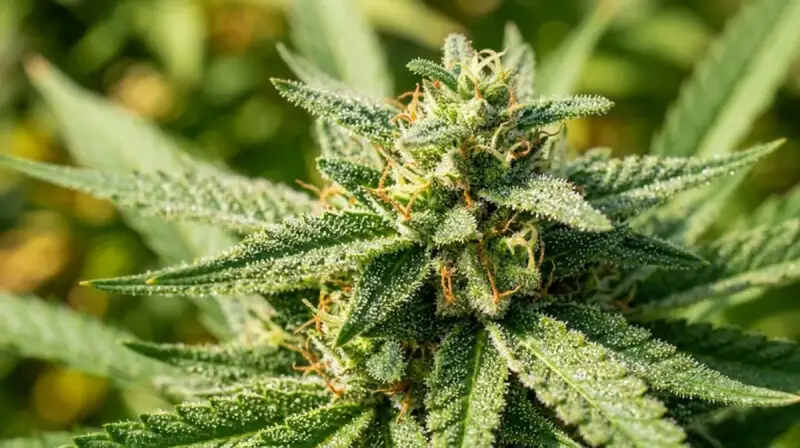
- Total seed-to-harvest time ranges from 8 weeks (fast autoflowering) to 32+ weeks (long-season outdoor photoperiod strains) depending on genetics and method.
- Autoflowering strains skip photoperiod sensitivity entirely — they flower based on age, not light hours, making them faster and simpler to grow.
- Sexing plants at week 4–6 of vegetative growth is critical — male plants must be removed before they pollinate females and ruin the entire crop.
- The harvest window is determined by trichome colour change: clear → milky → amber over a 2–3 week window.
- Environmental control — temperature, humidity, and VPD — is as important as nutrients at every stage.
- The seedling stage is the most fragile: overwatering and excess light are the most common causes of early failure.
Growth Stages Overview
| Stage | Duration | Light Schedule | Temperature | Humidity | Key Tasks |
|---|---|---|---|---|---|
| Germination | 1–10 days | Not critical | 22–28°C | 70–90% | Keep warm and moist; wait for taproot |
| Seedling | 2–3 weeks | 18/6 or 20/4 | 20–26°C | 65–70% | Soft light, minimal water, no feeding |
| Vegetative | 2–8 weeks | 18/6 | 22–28°C | 50–70% | High-N feed, training, sexing |
| Pre-flower | 1–2 weeks | 12/12 (flip) | 22–26°C | 50–60% | Transition feed; remove males |
| Flower | 6–12 weeks | 12/12 | 20–26°C | 40–50% | Bloom feed, low N; defoliation |
| Late Flower / Ripening | 1–3 weeks | 12/12 | 18–24°C | 35–45% | Monitor trichomes; begin flush |
| Harvest | 1 day | — | — | — | Cut, trim, hang to dry (10–14 days) |
Germination (Days 1–10)
Germination is the process of the seed cracking open and the taproot emerging. Cannabis seeds need warmth (22–28°C), moisture, and darkness to germinate successfully. Three reliable methods:
- Paper towel method — place seeds between damp paper towels on a plate; cover with another plate; keep warm (25°C ideal). Taproot appears in 1–5 days. Transplant when taproot is 1–2 cm long.
- Direct into medium — plant seed 1–1.5 cm deep in moist (not wet) seedling mix. No nutrients in medium at this stage. Avoid disturbing until seedling emerges.
- Water glass soak — soak seeds in room-temperature water for 12–24 hours until the seed sinks or cracks. Then transfer to paper towel or direct to medium.
The most common germination failure is overwatering. Seeds need moisture, not flooding. If using the paper towel method, the towels should be damp — not dripping.
Seedling Stage (Weeks 1–3)
Once the seed cracks open and the taproot pushes the seedling upward, the cotyledons (the first round embryonic leaves) open and begin photosynthesis. True cannabis leaves follow, starting as single-bladed leaves and progressing to the recognisable serrated multi-blade leaves.
Key seedling rules:
- Light distance — keep grow lights further away than for mature plants. Seedlings are delicate; too much light causes bleaching and stress. Start with lights at 60–80 cm above.
- Watering — the most common seedling killer is overwatering. Water in a small circle around the stem only — not the entire pot. Allow the top layer to dry slightly between waterings to encourage roots to grow downward seeking moisture.
- No feeding — seedling mix or quality soil provides everything needed for the first 2–3 weeks. Adding nutrients at this stage risks burning the delicate root system.
- Humidity — seedlings absorb water partly through their leaves at this stage. Keep relative humidity at 65–70%. A dome or humidity tent helps.
Vegetative Stage (Weeks 3–11)
The vegetative stage is the main growth phase. Under 18 hours of light per day, cannabis grows rapidly — building roots, stems, branches, and leaf area. This structural mass is what determines the final yield potential: a larger, healthier plant in veg produces larger harvests in flower.
During veg, plants need:
- Nitrogen-heavy feeding — high-N vegetative nutrient formulas drive leaf and stem growth
- Strong light — 18 hours/day; LED grow lights should be at manufacturer-recommended distance
- Training — this is when low-stress training (LST), topping, FIMing, and screen of green (SCROG) techniques are applied to create a wider, flatter canopy
- Regular transplanting — move to progressively larger pots as roots fill the container; root-bound plants stall
Veg length is one of the most controllable variables in indoor growing. A longer veg creates a bigger plant with more bud sites. Most indoor growers veg for 4–8 weeks depending on space and desired yield.
Sexing Your Plants
Cannabis is dioecious — plants are either male or female. Only female plants produce the resinous buds harvested for consumption. Male plants produce pollen sacs. If a male pollinates females, the females produce seeds instead of resin — this destroys the harvest.
Pre-flowers appear in the nodes (where branches meet the main stem) during weeks 4–6 of vegetative growth, or during the transition to flower:
- Female pre-flowers — two white hair-like pistils emerge from a small calyx (teardrop-shaped structure). This is the start of a bud site.
- Male pre-flowers — small round pollen sacs, often in clusters, shaped like tiny balls on a stalk. Remove male plants immediately upon identification.
- Hermaphrodite plants — both male and female organs on the same plant, usually caused by stress (light leaks, temperature extremes, physical damage). Remove or isolate immediately.
Using feminised seeds eliminates the risk of males entirely. Autoflowering seeds are almost always feminised. Regular seeds have a roughly 50/50 male/female ratio.
Flowering Stage (Weeks 1–12 of Flower)
Flowering is triggered by switching the light cycle to 12 hours on / 12 hours off (indoors) or by natural day-length reduction (outdoors in late summer). The plant dramatically changes priorities: vegetative growth slows, nitrogen demand drops, and energy redirects to bud production.
Week 1–3 (stretch and early bud): Plants can double or triple in height during the first 3 weeks of flower — this is called the “stretch.” White pistils appear at all bud sites. Transition your nutrient feed from veg to bloom formula gradually during weeks 1–2.
Week 3–6 (bud development): Buds form and swell around the calyxes. Trichome production begins. Maintain low humidity (40–50%) to prevent mould in dense buds. High P and K feed is at maximum.
Week 6–harvest (ripening): Bud swelling continues; trichomes change from clear to milky to amber. Pistils darken from white to orange. Begin taper off nutrients and transition to flush phase.
Late Flowering & Reading Trichomes
Trichome colour is the most reliable harvest indicator. Use a jeweller’s loupe (60–100x) or a digital microscope to examine the trichomes on the buds — not the leaves, which mature faster:
- Clear trichomes — still developing; THC not yet at peak. Harvest here produces weak, anxiety-inducing effects.
- Milky/cloudy trichomes — THC at or near peak concentration. Effects are more cerebral and energetic.
- Amber trichomes — THC degrading to CBN (a more sedating cannabinoid). Effects become more body-focused and sedating.
Most growers target 70–80% milky with 10–20% amber for a balanced effect. The harvest window from first amber trichomes to past-peak is typically 2–3 weeks. Pistil colour change (50–70% orange/red) is a useful secondary indicator but less precise than trichome inspection.
Autoflowering Cannabis: The Accelerated Timeline
Autoflowering cannabis (primarily Cannabis ruderalis genetics crossed with indica or sativa) flowers automatically based on age — not light hours. This has major practical implications:
- Total grow time: 8–12 weeks from seed to harvest, regardless of light schedule
- No light flip required — can be grown under 18/6 or even 20/4 light throughout
- Multiple harvests per year — outdoors, two or three auto crops are possible in a single growing season
- Smaller plants — autoflowers are generally more compact; training must be gentler as recovery time is limited by the fixed timeline
- No revegging — autoflowering plants cannot be cloned successfully or reverted to veg; every plant is started from seed
Environmental Requirements by Stage
| Stage | Temp Day | Temp Night | RH | VPD Target | Airflow |
|---|---|---|---|---|---|
| Seedling | 22–26°C | 20–22°C | 65–70% | 0.4–0.8 kPa | Gentle; no direct fan on seedlings |
| Vegetative | 22–28°C | 18–22°C | 50–70% | 0.8–1.2 kPa | Moderate oscillating fan |
| Early Flower | 20–26°C | 18–22°C | 45–55% | 1.0–1.5 kPa | Good circulation; prevent hotspots |
| Mid–Late Flower | 18–24°C | 16–20°C | 35–45% | 1.2–1.8 kPa | Strong; botrytis prevention critical |
| Drying / Cure | 15–20°C | Same | 50–60% | — | Slow air movement; no direct fan on buds |