










Cardiff Cannabis Travel Guide
Cardiff is the capital and largest city of Wales — a compact, walkable city of around 360,000 people that punches well above its weight culturally. It is the seat of the Welsh Senedd (parliament) and the centre of Welsh-language media (BBC Wales, S4C), but it is the city's music heritage that places it on any serious counterculture map. The 1990s Cool Cymru explosion — Super Furry Animals, Manic Street Preachers, Catatonia, Feeder, Stereophonics — produced a body of work that remains as culturally significant as any equivalent English city scene of the era. For cannabis-aware visitors, Cardiff offers the same legal context as England (Class B, Misuse of Drugs Act 1971), a vibrant student population, and a neighbourhood character — particularly in Roath, Cathays, and Pontcanna — that rewards independent exploration.
- Cannabis is a Class B offence under the Misuse of Drugs Act 1971 — up to 5 years for possession, 14 years for supply
- Wales is a devolved nation but drug policy remains reserved to Westminster — the Welsh Senedd cannot change cannabis laws
- CBD products with <0.2% THC are fully legal across Wales and widely available in Cardiff
- Super Furry Animals (Cardiff, formed 1993) were among the most explicitly cannabis-associated British bands of the 1990s
- Manic Street Preachers formed in Blackwood (35 miles from Cardiff) — their literary working-class politics and ambivalent counterculture stance became a defining Welsh cultural export
- Welsh devolution: the Senedd Cymru gained legislative powers in 1999 (Wales Act 2017 expanded these) but cannabis policy remains reserved
UK Cannabis Law in Wales: What Cardiff Visitors Need to Know
Drug policy in Wales is reserved to the UK Parliament at Westminster — the Welsh Senedd (which has legislative competence over health and education) cannot decriminalise, regulate, or otherwise change the legal status of cannabis in Wales. The Misuse of Drugs Act 1971 applies to Cardiff identically to how it applies to Cardiff identically to how it applies to London or Manchester. Cannabis is a Class B controlled substance. Possession carries up to 5 years imprisonment and/or an unlimited fine. Supply carries up to 14 years.
South Wales Police exercise discretion on minor possession, and a Cannabis Warning (formal caution) or Penalty Notice for Disorder (£90) is possible for first-time possession of a small personal amount. However, this is officer discretion, not policy, and visitors — particularly international tourists — should not rely on it. Cardiff city centre, Cardiff Bay, and the Millennium Stadium area have police visibility. For complete legal information, see the UK Government's official penalties page. For harm reduction context, Release (UK drugs charity) and Transform Drug Policy Foundation provide authoritative guidance.
Super Furry Animals: Cardiff's Most Cannabis-Associated Band (1993–Present)
Super Furry Animals are the most overtly cannabis-associated band in Welsh music history, and one of the most explicitly so in all of 1990s British music. Formed in Cardiff in 1993 by Gruff Rhys (vocals), Cian Ciarán (keyboards), Guto Pryce (bass), Huw Bunford (guitar), and Dafydd Ieuan (drums), the SFAs emerged from the Welsh-language music scene (Y Cymry scene) before crossing over to UK-wide success with Creation Records. Their debut album Fuzzy Logic (1996) and the follow-up Radiator (1997) established them as one of the most sonically adventurous acts of the Britpop era — a band that absorbed krautrock, Welsh folk, bubblegum pop, and heavy psychedelia into something entirely their own.
The cannabis connection was explicit and documented: Gruff Rhys discussed cannabis use in interviews throughout the 1990s, the band were associated with a legendarily stoned BBC session that resulted in a ban, and lyrics across their catalogue reference altered states, paranoia, and the particular quality of Welsh pastoral psychedelia. Radiator's "The International Language of Screaming" and "Hermann Pauline" remain touchstones of late-1990s psychedelic rock. Later albums — Guerrilla (1999), Mwng (2000, entirely in Welsh), and Rings Around the World (2001) — extended the SFAs' influence well beyond their contemporaries. Gruff Rhys's extensive solo career continues to produce psychedelia-inflected Welsh music with no diminishing returns.
Manic Street Preachers: Blackwood, Politics, and the Welsh Literary Tradition (1986–Present)
The Manic Street Preachers did not emerge from Cardiff itself — they formed in Blackwood, Caerphilly, a former coal-mining town 18 miles from the capital — but their cultural centre of gravity has always been the South Wales valleys and Cardiff. James Dean Bradfield, Nicky Wire, Sean Moore, and Richey Edwards formed in 1986 and spent several years in near-obscurity before their debut album Generation Terrorists (1992) announced them as something unprecedented in British music: a band obsessed with theory, literature, and political history rather than the usual rock'n'roll reference points.
The Manics' relationship with substance culture is complex and largely not celebratory — Richey Edwards's struggles with self-harm, eating disorders, and eventually his disappearance in 1995 (aged 27, never found, legally declared dead in 2008) cast a shadow over any simple narrative of rock excess. However, the band's literary references — Situationist theory, feminist writing, Sylvia Plath, Philip Larkin — and their positioning within South Wales working-class culture placed them within a countercultural tradition that included cannabis without celebrating it uncritically. Their later albums The Holy Bible (1994, written before Richey's disappearance), Everything Must Go (1996), and This Is My Truth Tell Me Yours (1998) remain among the most artistically serious bodies of work in British rock.
Catatonia, Stereophonics, and the Cool Cymru Moment (1993–2002)
Catatonia — led by Cerys Matthews, one of the defining voices of 1990s Welsh music — formed in Cardiff in 1990 and produced two albums that defined the Cool Cymru peak: International Velvet (1998, named after a Welsh national rugby touchstone) and Equally Cursed and Blessed (1999). Matthews's earthy, direct personality and the band's bilingual (Welsh/English) approach embodied Welsh cultural confidence at the moment of devolution. Their music drew on country, pub rock, and indie in a combination that felt specifically Welsh. Stereophonics, from Cwmaman (Cynon Valley), delivered a harder, more direct form of Welsh rock with Word Gets Around (1997) and Performance and Cocktails (1999) — both massive UK commercial successes. Feeder (Newport) added post-grunge to the Cool Cymru portfolio. All of these scenes shared a social backdrop — post-industrial South Wales communities, the closure of the coalfields, high youth unemployment — in which cannabis was a documented part of everyday culture.
Cardiff Neighbourhoods: Cannabis-Culture Context
| Neighbourhood | Character | Cannabis Culture Context |
|---|---|---|
| Roath & Cathays | Student area, City Road, independent shops | Cardiff's bohemian heartland; highest student density; City Road has the most independent retail and café culture |
| Pontcanna & Canton | Creative class, media workers, young professionals | BBC Wales and S4C staff; independent food and drink; Pontcanna Fields equivalent to Kelvingrove or Hyde Park |
| Cardiff Bay (Bae Caerdydd) | Regenerated waterfront, Senedd, Wales Millennium Centre | Tourist and political district; high police presence; Norway House (gig venue) in the Norwegian Church arts centre |
| City Centre | Royal Arcade, Morgan Quarter, Cardiff Castle | Independent retail in Victorian arcades; Clwb Ifor Bach (Welsh-language music venue, key Cardiff live spot) |
| Grangetown | Working class, multicultural, community | Cardiff's most diverse neighbourhood; South Asian, Somali, and Caribbean communities; alternative food culture |
| Penarth (nearby) | Victorian coastal town, 5 miles from Cardiff | Quiet, affluent; good base for day-visits; Turner House Gallery; Wales' coastline accessible from Cardiff |
Clwb Ifor Bach and Cardiff's Live Music Scene
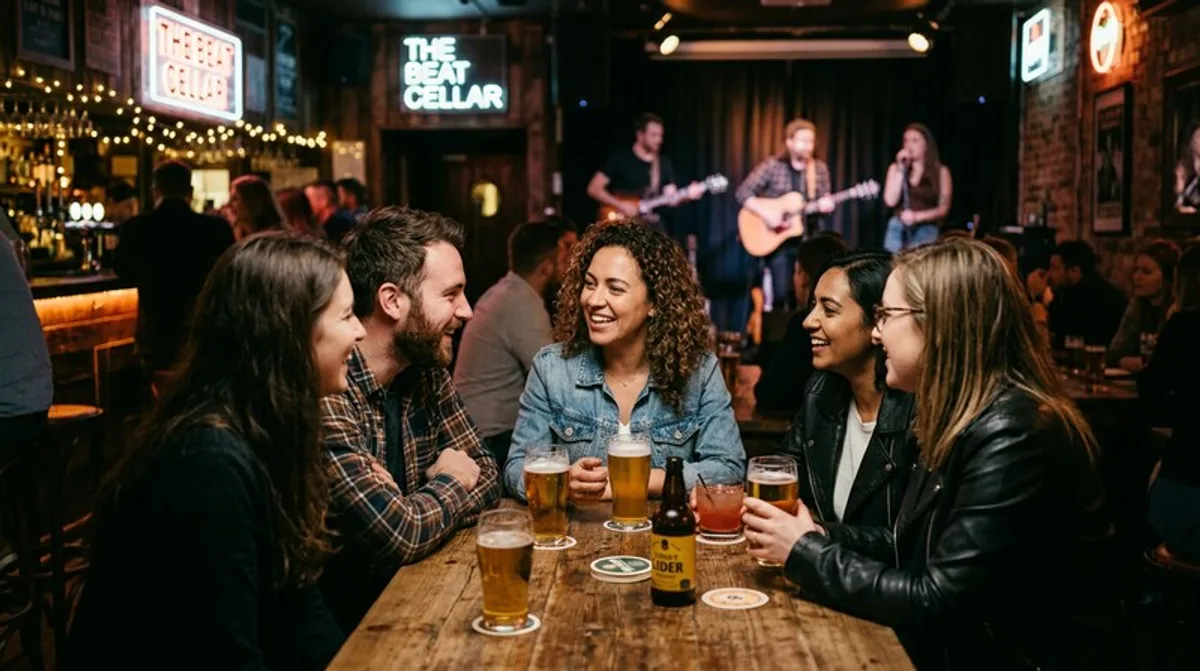
Clwb Ifor Bach ("Ifor's Little Club") on Womanby Street is the single most important live music venue in Cardiff's countercultural history. Named after Ifor Bach, the 12th-century Lord of Senghenydd who famously broke into Cardiff Castle, the club opened in 1983 and has operated continuously since as both a Welsh-language cultural institution and a venue for the indie and rock scenes that built Cool Cymru. Super Furry Animals, Catatonia, and Feeder all played early sets at Clwb Ifor Bach. It remains the essential Cardiff gig experience — a two-floor venue (capacity approximately 460) with a dedicated Welsh-language programming strand and one of the cheapest bar prices in Cardiff.
Womanby Street — now Cardiff's music street — has been the subject of ongoing campaigns against noise-complaint-led venue closures, with Cardiff Council eventually issuing a "agent of change" protection in 2017 that prevents new residential developments from using noise complaints to close established venues. Cardiff's other key live venues include SWN Festival (annual, October, multi-venue city-wide), The Globe in Roath, and the 1,700-capacity Cardiff University Students' Union. The Wales Millennium Centre in Cardiff Bay hosts larger-scale events and the BBC National Orchestra of Wales.
Welsh Language and Cannabis Culture
Cardiff is unusual among UK capitals in having a significant Welsh-language minority population — approximately 15% of Cardiff residents speak Welsh, and the language is visible in signage, media, and cultural life in ways that distinguish the city from any English equivalent. The Welsh-language music scene (Y Cymry, or "the Welsh") predates Cool Cymru and provided the cultural infrastructure from which Super Furry Animals and several other acts emerged. Gruff Rhys's bilingual career — English-language SFAs albums alternating with Welsh-language projects and collaborations — represents a continuous thread of psychedelia and social commentary that draws implicitly on cannabis culture throughout.
Welsh devolution (1997 referendum, implemented 1999) gave Wales its own parliament (initially National Assembly, renamed Senedd Cymru in 2020). The Senedd has competence over health policy but NOT over criminal law or drug policy — meaning Wales cannot decriminalise cannabis even if it wished to. The Drug Science charity and Transform Drug Policy Foundation have both noted that devolution creates an anomalous situation where Wales can run drug harm-reduction services but cannot change the underlying criminality of possession.
Practical Visitor Information
| Topic | Detail |
|---|---|
| Getting There | Cardiff Airport (CWL) — limited international routes; Bristol Airport (BRS, 45 min by bus) is the practical UK gateway. Cardiff Central station: direct trains from London Paddington (2h), Bristol (50 min), Manchester (3h) |
| Getting Around | Cardiff is compact and walkable — city centre, Roath, Cathays, and Canton are all within 30 minutes on foot from Cardiff Central. Bus network covers outer areas. Taxis and Uber available |
| Airport Warning | Cardiff Airport has UK Border Force and baggage screening. Do not travel with cannabis of any kind. Bristol Airport (BRS) applies identical enforcement |
| Key CBD Areas | City Road (Roath), Canton, Pontcanna, Royal Arcade — health food shops and specialist retailers throughout |
| Annual Events | Cardiff Half Marathon (October), SWN Festival (October), Hay Festival (Hay-on-Wye, 1h from Cardiff, May), Green Man Festival (Brecon Beacons, August) |
Green Man Festival: Welsh Counterculture at Scale
Green Man Festival, held annually in the Brecon Beacons (approximately 50 miles north of Cardiff), is Wales's premier outdoor music festival and one of the UK's best independent festivals by almost any measure. Founded in 2003, it has grown to approximately 25,000 attendees across five stages in the Glanusk Estate, with a programming focus on folk, indie, psychedelia, and experimental music that makes it ideologically compatible with cannabis culture in ways that its urban equivalents rarely achieve. Green Man is regularly cited in the same breath as Glastonbury for atmosphere. Like all major UK outdoor festivals, cannabis is present in significant quantities, and the festival's geography (remote valley location, limited police presence compared to Reading or Leeds) has historically made it one of the UK's most relaxed festival environments. Travel from Cardiff to Green Man requires either a hire car or the official festival bus service.
Related UK Cannabis Travel Guides
More UK Cities