










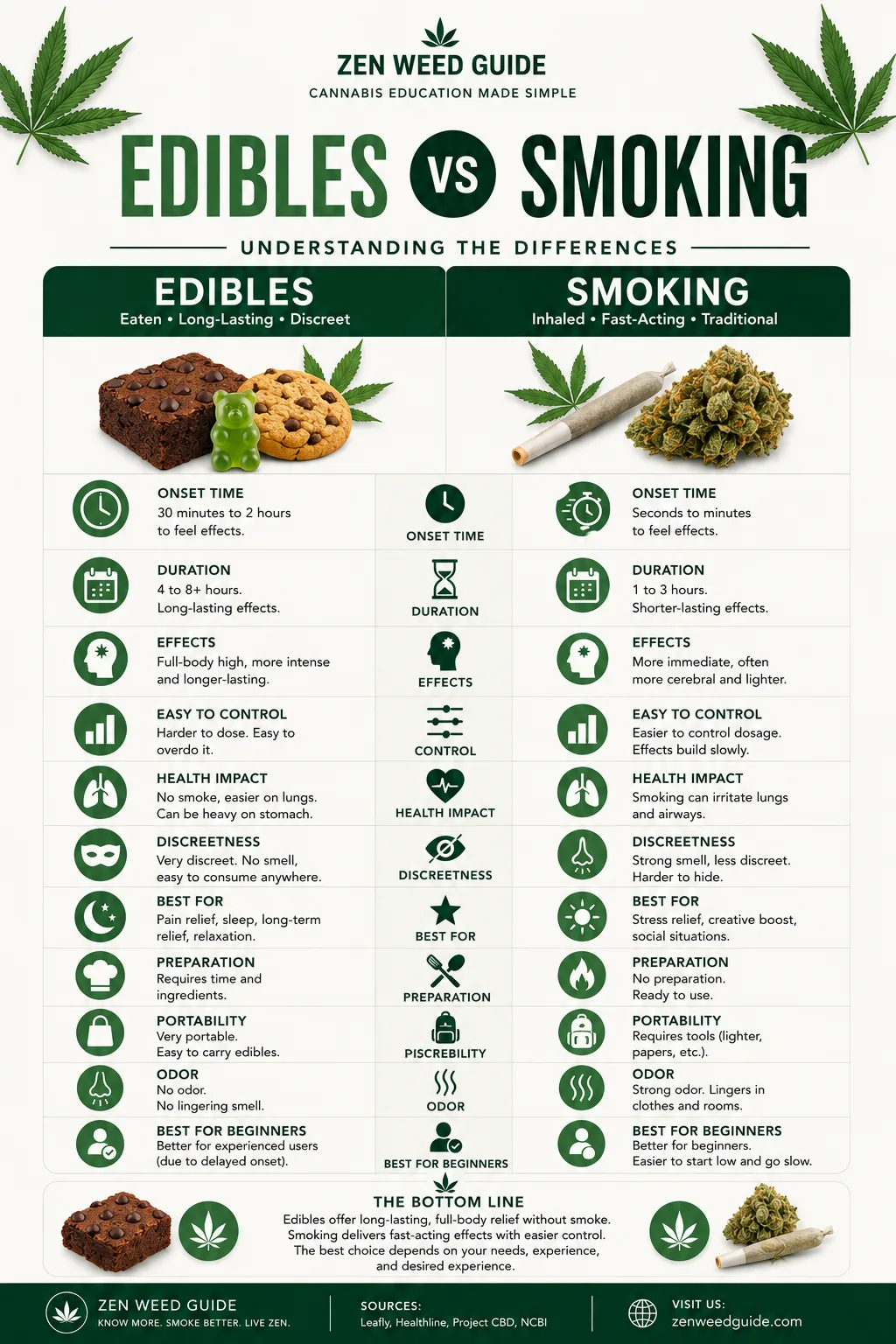
- Smoked cannabis reaches peak plasma THC within 3 to 10 minutes; edibles typically peak at 90 to 180 minutes — a 15 to 20x difference in time-to-peak.
- Edible effects last 4 to 8 hours on average versus 1 to 3 hours for smoking, making edibles more cost-efficient for long-duration medical use.
- The first-pass hepatic effect converts 30 to 50% of ingested THC to 11-OH-THC, which is more potent at CB1 than delta-9-THC — the primary reason edibles feel qualitatively stronger at the same labelled dose.
- 1g of 20% THC flower contains approximately 200mg of THC in raw form; effective delivery via smoking is 30 to 56% = 60 to 112mg systemic THC. A comparable edible effective dose is only 20 to 30mg due to the 11-OH-THC potency multiplier.
- Smoking cannabis is associated with chronic bronchitis with long-term daily use; edibles carry zero respiratory risk from the consumption method.
- Oral bioavailability of THC is 10 to 20% from standard edibles but increases to up to 30% when consumed with a high-fat meal via lymphatic absorption.
- Dose titration is essentially real-time with smoking (effects felt within minutes, can stop at any moment) whereas edible dosing must be planned in advance with a minimum 2-hour wait before assessing effect.
Onset Time: The Data Side by Side
The pharmacokinetic difference between smoked and ingested cannabis is one of the most dramatic in recreational pharmacology. Inhaled THC passes from alveoli directly into pulmonary capillaries and reaches the brain within 1 to 5 minutes. Peak plasma concentration typically occurs at 3 to 10 minutes post-inhalation. This is faster than most intravenous medications and explains why smoking provides such precise real-time dose control: you feel the effect almost as the molecule delivers itself.
Ingested THC must travel from the stomach, through intestinal absorption, through the portal vein, through first-pass hepatic metabolism, and then into systemic circulation before crossing the blood-brain barrier. This process takes 30 to 120 minutes for initial effects to appear and 90 to 180 minutes to reach peak concentration. The delay is not a sign that the edible is weak. The first-pass effect means the active molecule arriving at the brain (11-OH-THC) is more potent, not less.
| Metric | Smoking (Joint) | Vaporisation | Edible | Sublingual Tincture |
|---|---|---|---|---|
| First effects | 1 to 5 min | 1 to 3 min | 30 to 120 min | 15 to 45 min |
| Peak plasma | 3 to 10 min | 5 to 15 min | 90 to 180 min | 30 to 90 min |
| Duration | 1 to 3 hrs | 1 to 2.5 hrs | 4 to 8 hrs | 2 to 4 hrs |
| Bioavailability | 30 to 56% | 55 to 83% | 10 to 20% | 25 to 40% |
| Dose control | Real-time | Real-time | Pre-planned | Semi-real-time |
| Lung risk | Yes (combustion) | Reduced vs smoking | None | None |
The First-Pass Effect: Why Edibles Feel Different
First-pass hepatic metabolism is the process by which substances absorbed from the gastrointestinal tract are processed by the liver before entering systemic circulation. For cannabis, this means delta-9-THC encounters CYP2C9 and CYP3A4 liver enzymes before reaching the brain. Between 30 and 50% of absorbed THC is converted to 11-hydroxy-THC at this stage.
11-OH-THC has a higher log P value than delta-9-THC (more lipophilic), which means it crosses the blood-brain barrier more readily. CB1 receptor binding studies show 11-OH-THC has equivalent or greater affinity compared to the parent compound. It also has a longer elimination half-life, contributing to the extended duration of edible effects. The practical implication: a 10mg edible dose produces a qualitatively different and often subjectively more intense experience than 10mg delivered via inhalation, even though the bioavailability of the edible is lower. You are delivering a different primary active molecule.
Dose Equivalency: What 1g of Flower Actually Equals in Edible Terms
This is one of the most misunderstood questions in cannabis dosing. Consider a 1g joint using 20% THC flower. The raw THC content is 200mg. Smoking efficiency — accounting for combustion loss, sidestream smoke, and variable inhalation technique — typically delivers 30 to 56% of available THC, so approximately 60 to 112mg enters the lungs. Pulmonary bioavailability of 30 to 56% means approximately 18 to 63mg reaches systemic circulation. This arrives as delta-9-THC.
Now consider an edible. To produce a “comparable” experience — meaning similarly significant intoxication — you do not need 60 to 112mg. Because the liver converts ingested THC to the more potent 11-OH-THC, and because cannabis effects are not purely linear with dose, a 20 to 30mg edible dose typically produces an effect most users would characterise as equivalent in intensity to smoking that 1g joint, despite containing far less total THC. For a new user transitioning from smoking to edibles, this is the number one point of miscalculation that leads to over-intoxication.
| Smoked Flower Session | Approx. Systemic THC Delivered | Comparable Edible Dose | Note |
|---|---|---|---|
| 2 to 3 puffs (light) | 5 to 15mg | 5mg | Start here when transitioning |
| Half joint (0.5g, 20% THC) | 15 to 30mg | 10 to 15mg | 11-OH-THC multiplier applies |
| Full joint (1g, 20% THC) | 30 to 60mg | 20 to 30mg | Experienced users only |
| Blunt (2g, 20% THC) | 60 to 112mg | 30 to 50mg | High-tolerance territory |
Health Risk Comparison
Cannabis smoke contains many of the same combustion byproducts found in tobacco smoke: carbon monoxide, benzene, polyaromatic hydrocarbons, and fine particulate matter. Unlike tobacco, cannabis has not been definitively linked to lung cancer in moderate users — possibly due to lower total volume smoked per day and to THC’s potential anti-proliferative properties at the cellular level. However, daily heavy smoking is clearly associated with cannabis-associated hyperemesis syndrome and chronic bronchitis characterised by increased mucus production, coughing, and wheezing.
Edibles carry none of these inhalation risks. The gastrointestinal system handles the delivery and the only organ-level concerns are related to the THC itself (liver metabolism, cardiovascular effects from CB1 activation at high doses, psychiatric effects in vulnerable individuals) rather than the delivery route. For medical patients, especially those with asthma, COPD, or other respiratory conditions, edibles are the clearly recommended consumption method.
When to Choose Each Method
Choose smoking or vaporisation when you need fast onset and precise real-time dose control — for example, acute breakthrough pain, social situations where you want to titrate carefully, or when the total session is time-limited. Vaporisation is preferable to smoking for respiratory health since it heats cannabis below combustion temperature.
Choose edibles when duration is the priority: overnight pain management, sleep disorders, all-day medical conditions, or any situation where you prefer not to smoke or smell of cannabis. Edibles are also the clear choice for anyone with respiratory conditions or who prefers a discreet, portable, odourless format. Always start low and wait the full 2 hours before assessing and potentially supplementing the dose.
Related Guides
- Cannabis Edibles Dosage Guide and Timeline
- How to Dose Cannabis Edibles: Step-by-Step Guide
- THC vs CBD Visual Guide
- Vaporising vs Smoking: Health Impact Comparison
- Sativa vs Indica vs Hybrid Visual Guide
- The Endocannabinoid System Explained
- Cannabis Tolerance Break: How and Why