










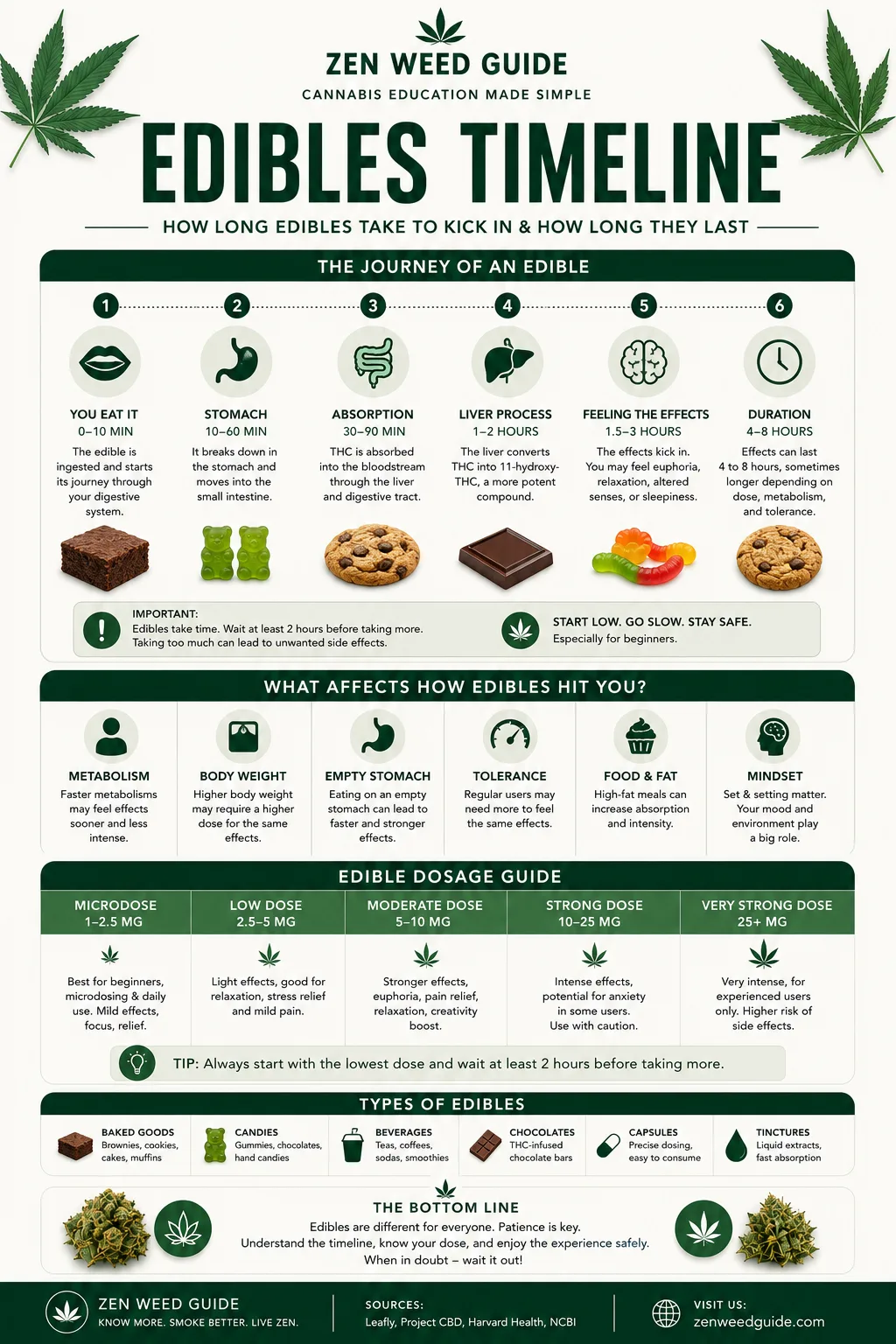
- The liver converts ingested THC into 11-hydroxy-THC (11-OH-THC), a metabolite roughly twice as potent as inhaled THC at the CB1 receptor.
- On an empty stomach, edible onset can be as fast as 30 minutes; after a high-fat meal, onset may extend to 2 hours but total absorption often increases.
- CYP2C9 genetic variants (found in roughly 7% of Europeans) slow THC metabolism, causing disproportionately intense or prolonged effects at standard doses.
- The single most common edible mistake is redosing before the first dose peaks — both doses then hit simultaneously.
- Oral THC bioavailability is 10 to 20%, far lower than inhaled (30 to 56%), which is why 10mg edible THC is not equivalent to 10mg inhaled THC.
- Sublingual tinctures bypass first-pass metabolism and can achieve onset in 15 to 45 minutes with higher bioavailability than swallowed edibles.
- CBD at 25 to 50mg taken alongside or shortly after too much THC can reduce subjective intoxication by modulating CB1 activity.
The 11-OH-THC Mechanism: Why Edibles Are a Different Drug
When you smoke or vaporise cannabis, THC absorbs directly through lung alveoli into the bloodstream and reaches the brain within 1 to 5 minutes. The primary active molecule throughout is delta-9-THC. When you eat cannabis, something fundamentally different happens. Delta-9-THC is absorbed through the intestinal wall and passes through the portal vein directly to the liver before reaching systemic circulation — this is called first-pass hepatic metabolism.
In the liver, CYP2C9 and CYP3A4 enzymes convert approximately 30 to 50% of ingested delta-9-THC into 11-hydroxy-THC (11-OH-THC). This metabolite is more lipophilic than delta-9-THC and crosses the blood-brain barrier with greater efficiency. Pharmacological studies indicate 11-OH-THC has equal or greater CB1 binding affinity compared to the parent compound. The result: edibles feel qualitatively different from smoking even when the labelled milligram dose appears modest. The sedation is deeper, the body load heavier, and the duration substantially longer.
Onset Time Factors: What Changes How Fast You Feel It
Four variables dominate onset timing. First, stomach contents: an empty stomach accelerates onset (30 to 60 minutes) because there is no competition from food fat and transit to the small intestine is faster. A meal high in dietary fat can slow onset to 90 to 150 minutes but can significantly increase total bioavailability because THC incorporates into chylomicrons (fat transport particles) that bypass portal circulation via the lymphatic system.
Second, product format: gummies or lozenges held in the mouth deliver some THC sublingually through the oral mucosa, bypassing the liver for that fraction and producing a partial faster onset. Hard swallowed capsules follow full gastrointestinal transit. Third, individual metabolism: people with the CYP2C9*3 variant metabolise THC significantly more slowly, leading to elevated plasma levels and prolonged effects that can feel disproportionate to dose. Fourth, tolerance: chronic daily users have upregulated clearance pathways and require higher doses to achieve equivalent effects.
Full Dose-Response Table: 1mg Through 100mg+
| Dose Range | Classification | Expected Effects | Duration | Best For |
|---|---|---|---|---|
| 1 to 2.5mg | Microdose | Sub-perceptual, mild focus lift, minimal anxiety reduction | 2 to 3 hrs | Productivity, medical micro-titration |
| 5mg | Beginner | Gentle relaxation, mood uplift, mild sensory enhancement | 3 to 4 hrs | First-timers, low-tolerance users |
| 10mg | Standard | Clear recreational effects, body relaxation, appetite increase | 4 to 6 hrs | Recreational, pain, sleep |
| 20mg | Strong | Intense euphoria, heavy sedation, impaired short-term memory | 5 to 8 hrs | Experienced users, severe pain |
| 30 to 50mg | Very High | Strongly psychedelic quality, extreme sedation, anxiety risk | 6 to 10 hrs | High-tolerance recreational, medical |
| 50 to 100mg | Expert/Medical | Intense dissociation possible, deep sleep induction | 8 to 12 hrs | Palliative care, cancer pain |
| 100mg+ | Clinical Territory | Extreme impairment, panic possible in naive users, vomiting | 10 to 14 hrs | Not recreational — medical protocol only |
Bioavailability Comparison: Edibles vs Sublingual vs Smoking
| Method | Bioavailability | Onset | Peak | Duration |
|---|---|---|---|---|
| Smoking (joint) | 30 to 56% | 1 to 5 min | 10 to 30 min | 1 to 3 hrs |
| Vaporisation | 55 to 83% | 1 to 3 min | 5 to 15 min | 1 to 3 hrs |
| Sublingual tincture | 25 to 40% | 15 to 45 min | 30 to 90 min | 2 to 4 hrs |
| Swallowed edible | 10 to 20% | 30 to 120 min | 90 to 180 min | 4 to 8 hrs |
| Edible with fatty meal | Up to 30% | 60 to 150 min | 120 to 240 min | 5 to 10 hrs |
The Redosing Trap and How to Avoid It
The most damaging mistake with edibles is taking a second dose because the first dose “hasn’t worked yet.” At 60 to 90 minutes, the first dose is typically still in the absorption phase and has not yet peaked. A second dose taken at this point will peak simultaneously with the first, delivering double the intended effect at the worst possible time. Many reported cannabis-related emergency room visits involve edibles consumed in two doses with a short interval between them.
The rule is simple: set a timer for 2 hours before even considering a second dose. If effects are modest at 2 hours, add no more than half the original dose and wait another 90 minutes. Write down what you took and when — this removes the psychological urge to redose when the effect is building subtly.
How to Recover from Too Much: Grounding Techniques and CBD
If you have taken too much, the most important fact is that no fatal cannabis overdose from edibles has ever been documented in medical literature. The experience will end. Remove yourself from any stressful environment. Lie or sit in a safe, familiar space. Practice box breathing: inhale for 4 counts, hold 4, exhale 4, hold 4 — this activates the parasympathetic nervous system and reduces the cortisol spike that amplifies cannabis-induced anxiety.
If available, taking 25 to 50mg of CBD can help. As a negative allosteric modulator of CB1, CBD reduces the receptor’s sensitivity to THC’s activation and can partially attenuate the over-intoxicated state within 20 to 45 minutes. Eating something — particularly black pepper, which contains beta-caryophyllene, a CB2 agonist with calming properties — is a traditional anecdotal remedy with at least partial scientific plausibility. Cold water, a walk in fresh air if outdoor conditions permit, and distraction via a familiar TV show or music are all effective tools. Avoid caffeine, which will amplify anxiety.
Related Guides
- How to Dose Cannabis Edibles: Step-by-Step Beginner Guide
- Edibles vs Smoking — Visual Comparison Infographic
- What Is THC? Complete Pharmacology Guide
- THC vs CBD Visual Guide
- Cannabis Tolerance Break: How and Why
- The Endocannabinoid System Explained