










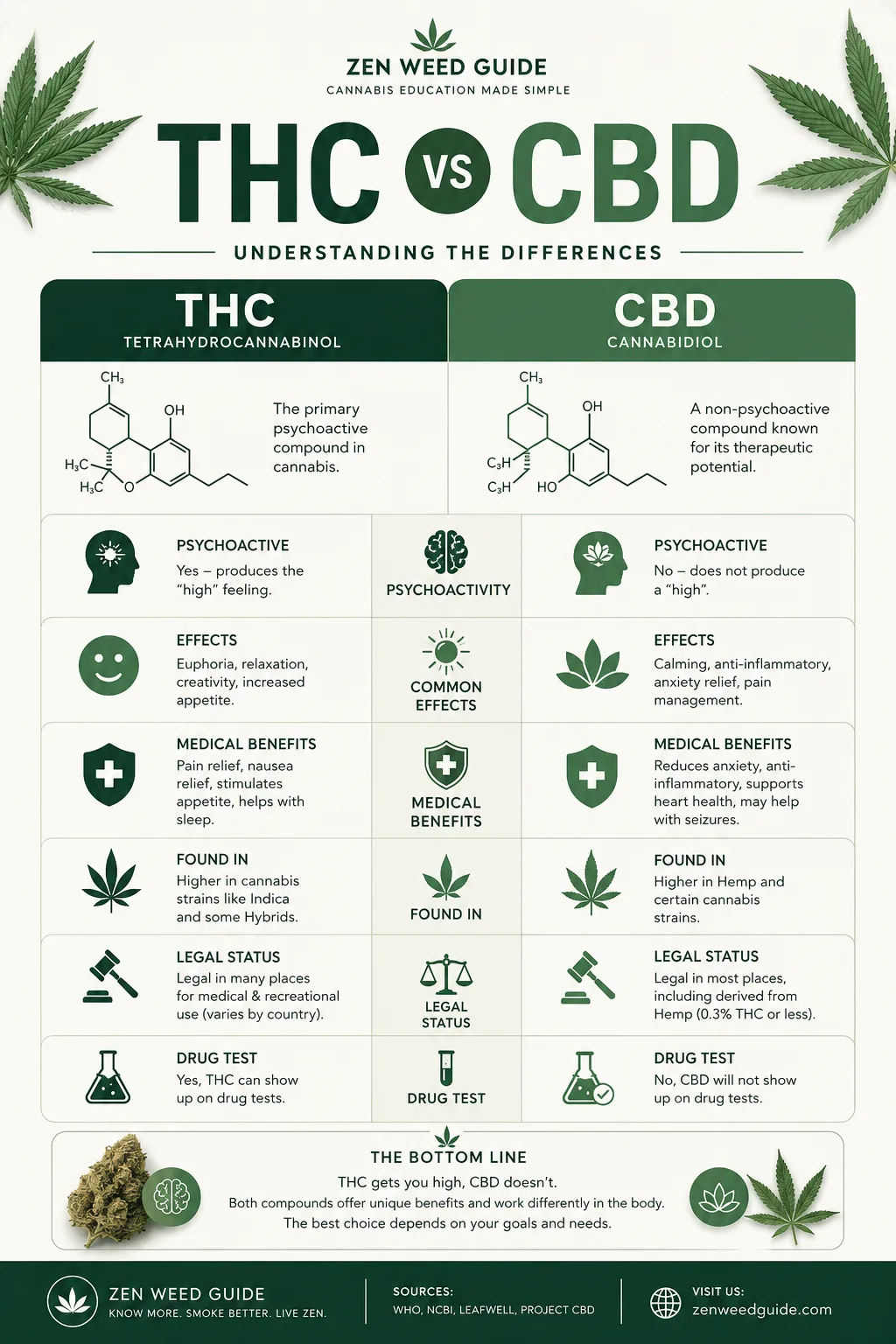
- THC is a direct CB1 agonist producing psychoactive effects; CBD is a negative allosteric modulator that dampens CB1 activity without binding as the primary agonist.
- Both share the molecular formula C21H30O2 but differ in the arrangement of a single hydroxyl group vs a cyclic ring — a small structural difference with massive functional consequences.
- THC-COOH accumulates in fat tissue; daily users can test positive on urine screens for up to 30 days after stopping.
- CBD is FDA-approved as Epidiolex for Dravet syndrome and Lennox-Gastaut syndrome, the strongest regulatory evidence either cannabinoid has for a specific condition.
- A 1:1 THC:CBD product reduces peak CB1 activation, lowering anxiety and paranoia risk while preserving therapeutic THC effects.
- Thirty-eight US states permit medical cannabis (THC-containing); hemp-derived CBD is federally legal in all 50 states under the 2018 Farm Bill.
- For neuropathic pain, the combination of THC and CBD outperforms either molecule alone in multiple randomised controlled trials.
How THC and CBD Bind Differently in the Brain
THC is a partial agonist at CB1 receptors, which are densely concentrated in the hippocampus, basal ganglia, cerebellum, and prefrontal cortex. When THC occupies CB1, it mimics the endocannabinoid anandamide but with much greater potency and a longer duration, producing the characteristic euphoria, altered time perception, increased appetite, and heightened sensory experience.
CBD does not bind CB1 as a primary agonist. Instead it acts as a negative allosteric modulator, physically changing the shape of the CB1 receptor so that THC (and anandamide) bind less efficiently. This is the biochemical reason a dose of CBD taken alongside THC reduces intoxication intensity. CBD also inhibits FAAH, the enzyme that breaks down anandamide, effectively raising the brain’s own endocannabinoid tone without producing a high. Additionally, CBD activates TRPV1 channels and 5-HT1A serotonin receptors, explaining its anxiety-reducing and anti-nausea effects.
Molecular Structure: Why One Small Difference Changes Everything
Both molecules share the formula C21H30O2 and a three-ring terpenophenolic scaffold. The critical difference is that THC contains a cyclic tetrahydropyran ring at the oxygen-bearing position, while CBD has a free hydroxyl group at the same position with an open isopropenyl tail. This structural distinction prevents CBD from accessing the CB1 binding pocket in the same way as THC. It also affects how each molecule is metabolised: THC is converted by CYP2C9 and CYP3A4 primarily into 11-OH-THC and then THC-COOH, while CBD is hydroxylated into 7-OH-CBD. The fat-solubility of THC-COOH is why it accumulates and is detectable long after the effects have faded.
Medical Evidence by Condition: THC vs CBD vs Combined
| Condition | THC Evidence | CBD Evidence | Combined Evidence |
|---|---|---|---|
| Neuropathic pain | Strong (RCTs) | Moderate | Strong (superior) |
| Chemotherapy nausea | Strong (FDA-approved) | Moderate | Strong |
| Epilepsy (rare forms) | Limited | Strong (FDA-approved) | Moderate |
| Anxiety (acute) | Mixed (can worsen) | Moderate (single-dose) | Moderate (1:1) |
| Appetite / cachexia | Strong | Weak | Moderate |
| Multiple sclerosis spasticity | Strong (Sativex) | Moderate | Strong (Sativex) |
| PTSD | Moderate | Emerging | Emerging |
| Sleep disorders | Moderate (short-term) | Moderate | Moderate |
| Inflammatory conditions | Moderate | Moderate (preclinical) | Moderate |
| Glaucoma (IOP) | Moderate (short-term) | Weak (may increase IOP) | Not recommended |
Drug Test Detection Windows
Standard workplace urine immunoassay screens test for THC-COOH, not THC itself. Because THC-COOH is fat-soluble, it is not excreted rapidly and detection windows correlate strongly with body fat percentage and frequency of use. A single-use event is typically detectable for 3 to 5 days. Weekly use extends detection to 7 to 10 days. Daily use can produce positive results for 21 to 30 days after the last dose. Blood tests detect active THC for only 3 to 6 hours after smoking, making them primarily useful in roadside impairment testing, not employment screening.
CBD does not cross-react on immunoassay tests designed for THC-COOH. However, full-spectrum CBD products containing up to 0.3% THC can accumulate enough THC metabolite for a false positive with heavy daily use. If you face drug testing, use CBD isolate or broad-spectrum products verified by a certificate of analysis showing undetectable THC.
| Use Pattern | Urine (THC-COOH) | Blood (THC) | Hair (THC-COOH) |
|---|---|---|---|
| Single use | 3 to 5 days | 3 to 6 hours | Up to 90 days |
| Weekly use | 7 to 10 days | 6 to 12 hours | Up to 90 days |
| Daily use | 21 to 30 days | Up to 24 hours | Up to 90 days |
| CBD isolate only | Not detected | Not detected | Not detected |
Understanding the 1:1 THC:CBD Ratio
A 1:1 product contains equal milligrams of THC and CBD per dose, for example 5mg THC + 5mg CBD per gummy. The CBD in the product acts as a built-in moderator of the CB1 activation that THC produces. Clinical trials for Sativex, the only 1:1 oromucosal spray with regulatory approval, demonstrated that patients using a 1:1 formulation reported less intoxication-related adverse events than matched THC-only controls while achieving equivalent pain relief.
For new consumers, a 1:1 product starting at 2.5mg THC / 2.5mg CBD is the gentlest entry point that still delivers meaningful therapeutic THC. As tolerance and familiarity develop, the ratio can be shifted toward higher THC concentrations. Avoid assuming that doubling the CBD will fully block a very high THC dose — the modulation has limits at saturation concentrations.
State Legal Status: Where Each Cannabinoid Stands
As of this writing, 24 US states plus Washington DC permit adult-use recreational cannabis (THC). Thirty-eight states permit medical cannabis programs with qualifying conditions. Hemp-derived CBD with under 0.3% THC is federally legal under the 2018 Farm Bill and available in all 50 states, though a small number of states imposed their own restrictions on CBD-infused food products. Internationally, THC legality varies enormously: Canada permits full adult-use nationally, Germany permits limited personal possession and social club cultivation, while many countries retain strict prohibition. CBD enjoys broader global acceptance but is not universally deregulated — the EU classifies CBD as a novel food requiring authorisation for food products.
Related Guides
- What Is THC? Complete Pharmacology Guide
- What Is CBD? Effects, Evidence, and Dosage
- Sativa vs Indica vs Hybrid — Visual Guide
- Edibles Dosage Chart and Timeline
- The Endocannabinoid System Explained
- Cannabis Drug Testing: What You Need to Know
- Edibles vs Smoking — Visual Comparison