










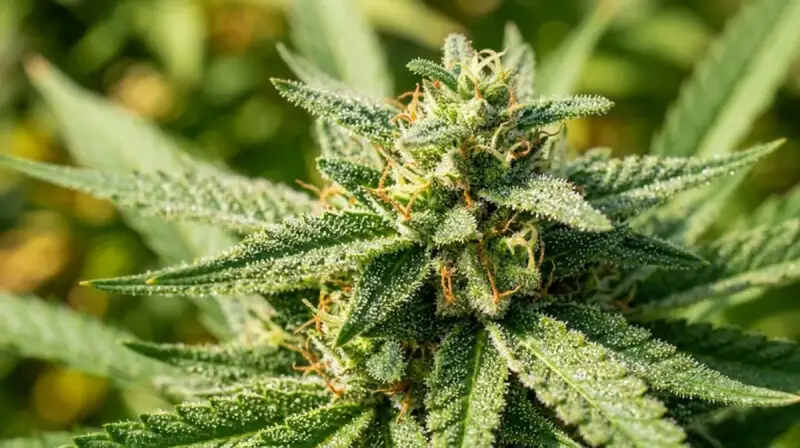
 caryophyllene terpene cannabis" loading="eager" fetchpriority="high">
- Dietary cannabinoid: BCP selectively activates CB2 receptors — confirmed by Gertsch et al., 2008 (PNAS).
- Non-psychoactive: CB2 agonism does not produce intoxication; BCP is FDA GRAS as a food flavoring.
- Anti-inflammatory: Inhibits NF-κB signaling and reduces pro-inflammatory cytokines (Bento et al., 2011).
- Analgesic: Reduced neuropathic pain in rodent models via peripheral CB2 activation (Klauke et al., 2014).
- Anxiolytic: Decreased anxiety and depression-like behavior in mice at 25–50 mg/kg (Bahi et al., 2014).
- Cannabis concentration: 0.1–1.2% of dry flower weight; often dominant terpene in OG/Cookies genetics.
- Black pepper trick: Smelling or chewing black pepper delivers caryophyllene — a folk remedy for THC-induced anxiety with molecular backing.
Chemical Profile & Properties
Beta-caryophyllene (BCP) is a bicyclic sesquiterpene (C15H24) with a rare cyclobutane ring fused to an eight-membered ring. This three-dimensional shape is critical to its CB2 receptor affinity. It is the trans isomer; cis-caryophyllene (isocaryophyllene) does not share the same receptor activity.
| Property | Value |
|---|---|
| Chemical class | Bicyclic sesquiterpene |
| Molecular formula | C15H24 |
| Molecular weight | 204.36 g/mol |
| Boiling point | 160°C (320°F) |
| Aroma profile | Spicy, peppery, woody, clove-like |
| Cannabis concentration range | 0.10–1.20% (mg/g: 1.0–12.0) |
| FDA status | GRAS (food flavoring) |
| CB receptor activity | Selective CB2 agonist (Ki ≈ 155 nM) |
| Natural abundance | Black pepper, cloves, copaiba, rosemary, hops, basil |
Mechanism of Action: How BCP Works in the Body
The endocannabinoid system features two primary receptors: CB1 (abundant in the brain and central nervous system) and CB2 (concentrated in immune cells, spleen, tonsils, bone marrow, gut, and peripheral nervous system). THC activates both; BCP activates only CB2.
When BCP occupies a CB2 receptor it triggers intracellular signaling that suppresses the NF-κB transcription pathway. NF-κB is a master switch for inflammation — it drives transcription of cytokines including TNF-α, IL-1β, IL-6, and COX-2. By dampening this pathway, BCP reduces the inflammatory cascade at its source rather than merely blocking downstream mediators as NSAIDs do. Because this occurs primarily outside the brain, there is no impairment of cognition or motor function.
Additionally, CB2 activation in peripheral nociceptors (pain-sensing neurons) reduces the release of substance P and CGRP, two key mediators of pain signaling. This explains the analgesic effects documented in neuropathic pain models independent of any central sedation.
Clinical & Preclinical Research
The following table summarizes peer-reviewed studies on beta-caryophyllene. Most evidence is preclinical; always consult a licensed physician before using cannabis therapeutically. See our effects library for broader context.
| Condition | Study | Dose / Model | Result | Evidence Quality |
|---|---|---|---|---|
| Inflammation | Gertsch et al., 2008 (PNAS) | In vitro + murine model | BCP identified as selective CB2 agonist; reduced LPS-induced TNF-α by ~45% | Strong (replicated) |
| Colitis / Gut inflammation | Bento et al., 2011 (JPET) | 50–200 mg/kg oral, mice | Dose-dependent reduction of colitis severity; restored tight-junction integrity | Strong (preclinical) |
| Neuropathic pain | Klauke et al., 2014 (Eur J Pharmacol) | 50 mg/kg oral, rats | Significant reduction in mechanical allodynia and thermal hyperalgesia | Moderate (animal) |
| Anxiety / Depression | Bahi et al., 2014 (Physiol Behav) | 25–50 mg/kg, mice | Decreased anxiety (EPM) and immobility (FST) via CB2; blocked by CB2 antagonist | Moderate (preclinical) |
| Anxiety (confirmation) | Junqueira et al., 2017 (Front Pharmacol) | 30 mg/kg, mice | Anxiolytic effect confirmed; no sedation at therapeutic dose | Moderate (preclinical) |
| Neuroinflammation | Viveros-Paredes et al., 2017 | In vitro microglial model | Reduced neuroinflammatory markers; potential relevance for neurodegenerative disease | Early (in vitro) |
| Alcohol dependence | Al Mansouri et al., 2014 (Pharmacol Biochem Behav) | 25 mg/kg, mice | Reduced voluntary alcohol intake; effect abolished by CB2 antagonist | Early (animal) |
Top Cannabis Strains Highest in Caryophyllene
Caryophyllene is among the three most abundant terpenes in commercially tested US cannabis. It dominates in OG Kush lineage, Cookies genetics, and many high-CBD cultivars. Figures below are derived from aggregated laboratory data; individual batch results vary. Always verify the COA for your specific product. Browse our full strain library.
| Strain | Type | BCP Range (%) | Other Dominant Terpenes | Primary Effect Profile |
|---|---|---|---|---|
| Girl Scout Cookies (GSC) | Hybrid | 0.50–1.10 | limonene, Humulene | Euphoria, stress relief, body relaxation |
| OG Kush | Hybrid (Indica-leaning) | 0.40–0.95 | myrcene, Limonene | Relaxation, pain relief, mood lift |
| Chemdawg | Hybrid | 0.45–1.00 | Myrcene, Limonene | Cerebral, energetic, creative |
| Sour Diesel | Sativa-dominant | 0.30–0.80 | Myrcene, Limonene | Energy, focus, mood elevation |
| Death Star | Indica-dominant | 0.55–1.20 | Myrcene, Humulene | Heavy sedation, pain, insomnia |
| Bubba Kush | Indica | 0.40–0.90 | Myrcene, Limonene | Deep relaxation, sleep aid |
| Gelato | Hybrid | 0.45–1.00 | Limonene, Humulene | Creativity, body calm, euphoria |
| Candyland | Sativa-dominant | 0.35–0.85 | Myrcene, linalool | Uplifting, social, mild pain relief |
| Zkittlez | Indica-dominant | 0.40–0.90 | Linalool, Humulene | Relaxation, mood, appetite |
| Purple Punch | Indica | 0.35–0.80 | Myrcene, Linalool | Sedation, sleep, body relief |
Entourage Effect: Synergy with Other Terpenes & Cannabinoids
The entourage effect describes how cannabis compounds interact to modulate each other’s effects. BCP exhibits several well-characterized synergies relevant to therapeutic applications. Explore the full terpene guide to understand how terpenes interact across the cannabis profile.
| Partner Compound | Combined Effect | Mechanism | Clinical Relevance |
|---|---|---|---|
| CBD | Enhanced anti-inflammatory & anxiolytic | BCP (CB2) + CBD (TRPV1, 5-HT1A) target complementary pathways | High — both GRAS/safe, no intoxication |
| Myrcene | Deeper sedation & muscle relaxation | Myrcene’s muscle-relaxant + BCP’s peripheral pain suppression | Moderate — evening/sleep formulations |
| Alpha-pinene | Synergistic anti-inflammatory | Pinene inhibits COX enzymes; BCP suppresses NF-κB upstream | Moderate — arthritic/inflammatory conditions |
| Humulene | Amplified anti-inflammatory; appetite suppression | BCP isomer; shares CB2 affinity; combined cytokine suppression | Moderate — both present in Cookies/OG genetics |
| THC | Pain modulation with reduced anxiety risk | CB2 activation may buffer CB1-mediated anxiety at low THC doses | Emerging — high-BCP:THC ratios anecdotally calmer |
| Linalool | Broad anxiolytic & anti-inflammatory stack | Linalool’s GABA-A modulation + BCP’s CB2 pathway; double anxiolytic | Moderate — daytime stress relief |
Non-Cannabis Natural Sources of Caryophyllene
BCP is one of the most abundant terpenes in the plant kingdom. Dietary intake from common foods may provide low-level CB2 stimulation on a daily basis — a hypothesis sometimes called the “dietary cannabinoid” effect.
- Black pepper (Piper nigrum): 10–35% of essential oil; highest accessible dietary source
- Cloves (Syzygium aromaticum): up to 12% of essential oil; traditional anti-inflammatory use
- Copaiba balsam (Copaifera spp.): 40–80% BCP — the richest botanical source; used in Amazonian folk medicine
- Rosemary (Rosmarinus officinalis): 1–8% of essential oil
- Hops (Humulus lupulus): 10–20% of essential oil; overlaps with cannabis terpene profile
- Basil (Ocimum basilicum): 3–10% of essential oil
- Oregano (Origanum vulgare): 2–8% of essential oil
- Cinnamon leaf (Cinnamomum zeylanicum): 1–5% of essential oil
TERPENE SCIENCE
Video: How Beta-Caryophyllene Activates CB2 Receptors
Frequently Asked Questions
Is beta-caryophyllene psychoactive?
No. Beta-caryophyllene binds exclusively to CB2 receptors, which are expressed mainly in immune and peripheral tissues rather than the central nervous system. CB2 activation does not produce intoxication. Caryophyllene can be consumed in large dietary amounts without any psychoactive effect — this is why the FDA classifies it as Generally Recognized As Safe (GRAS) as a food flavoring.
What does caryophyllene smell like?
Caryophyllene has a bold spicy, peppery aroma with woody and herbal undertones. It is the primary odor compound in black pepper and contributes the clove-like warmth to many culinary spices. In cannabis it manifests as a sharp earthy-spice note that sets OG and Cookies family cultivars apart from sweeter, fruitier varieties.
Can caryophyllene help with anxiety?
Preclinical data suggest anxiolytic properties. Bahi et al. (2014, Physiology & Behavior) demonstrated that beta-caryophyllene reduced anxiety and depression-like behavior in mice via CB2 activation. Junqueira et al. (2017) replicated comparable findings. Human trials remain limited, but the compound’s GRAS status and favorable safety profile make it a promising candidate. Combining caryophyllene-rich strains with CBD may amplify anxiolytic effects through the entourage mechanism.
At what temperature does caryophyllene vaporize?
Caryophyllene has a boiling point of approximately 160°C (320°F). Setting a vaporizer to 160–175°C (320–347°F) releases caryophyllene efficiently alongside other mid-range terpenes. Temperatures above 200°C risk degrading terpenes before inhalation. Starting low and gradually increasing temperature captures the full terpene spectrum sequentially.