










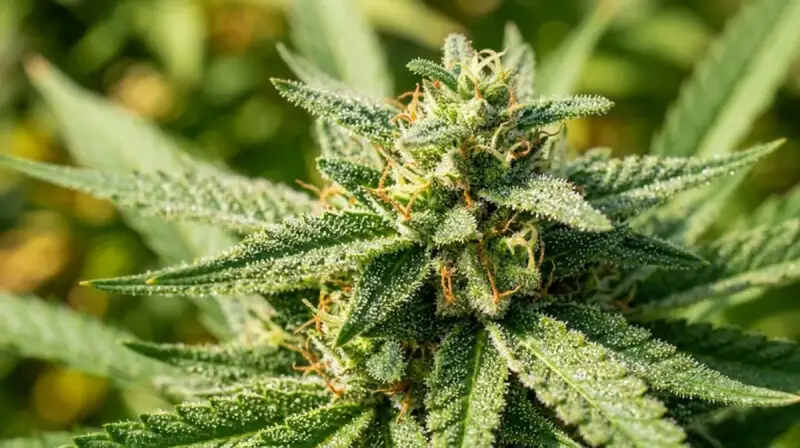
- Genetics: OG Kush × Sour Diesel
- Also Known As: Headband, Sour OG Kush
- THC Range: 18–24% (intermediate to experienced users)
- Top Terpenes: Myrcene, Caryophyllene, Limonene
- Main Effects: Clear-headed euphoria, balanced body relaxation, mood elevation, creativity
- Distinctive Feature: “Headband” pressure sensation at forehead and temples with higher doses
- Medical Uses: Stress, mild pain, depression, anxiety relief
- Yield (Indoor): 350–450g/m² | Outdoor: 450–550g per plant
- Aroma: Diesel, earth, citrus, pine — sharp and pungent
Genetics & Origin
Sour Kush is the product of two of the most iconic strains in modern cannabis history: OG Kush and Sour Diesel. Both parent strains are legendary in their own right, and their combination creates a balanced hybrid that honours each lineage without being dominated by either. OG Kush contributes deep body relaxation, a lemon-fuel terpene profile, and pronounced stress relief. Sour Diesel brings cerebral energy, a sharp diesel-citrus punch, and sustained mental clarity.
The cross appears in multiple versions across different breeders, which is why you’ll find Sour Kush marketed under several names depending on the seed source. The most widely recognised alias is Headband — named for the unique forehead pressure sensation experienced with higher doses. DNA Genetics, Reserva Privada, and several California-based breeders have all produced versions of this OG × Diesel cross. Phenotypic variation is broader than with more stabilised strains, but the core terpene signature — diesel, earth, citrus, pine — is consistent across all reputable versions.
The OG Kush side of the equation traces back to the legendary Florida-to-California OG Kush cut (itself believed to be Chemdawg × Hindu Kush or Lemon Thai × Hindu Kush × Chemdawg). Sour Diesel’s lineage is equally storied, believed to descend from Chemdawg 91, Super Skunk, and Northern Lights. The shared Chemdawg ancestry means Sour Kush carries a deep diesel terpene foundation that both parents reinforce from different directions.
The Headband Effect: What Causes It?
The “Headband” sensation is Sour Kush’s most talked-about characteristic — a distinct pressure around the forehead, temples, and sometimes the back of the skull that appears within 15–30 minutes of consumption, particularly at higher doses. It is not painful; most users describe it as a firm but comfortable tightness, like wearing a snug headband.
The exact physiological mechanism is not fully established, but several factors likely contribute. THC activates CB1 receptors in the cerebral vasculature, altering cerebral blood flow and vascular tone. The high Myrcene content in Sour Kush amplifies THC’s CNS penetration, while Caryophyllene’s CB2 activity may influence peripheral blood vessel tone. The combination appears to create a pressure differential that users experience as the characteristic headband sensation.
| Factor | Mechanism | When It Occurs | Intensity | How to Reduce |
|---|---|---|---|---|
| Cerebral vasodilation | CB1 activation alters cerebrovascular tone | 15–30 min post-consumption | Dose-dependent | Lower dose; slower inhalation |
| Myrcene amplification | Increases BBB permeability, THC CNS penetration | Concurrent with THC onset | Strain-dependent | Choose lower-myrcene pheno |
| Neck/trapezius tension | Pre-existing muscle tension amplified by body awareness | Throughout high | Variable (user condition) | Stretch before; hydration |
| Dehydration | THC reduces saliva production; mild dehydration increases head pressure | 30–60 min onwards | Mild | Water before and during session |
For most users the headband sensation is a neutral or even pleasant part of the experience — a confirmation that the strain has arrived. It typically fades as the overall high develops and is rarely reported as distressing by experienced consumers. Beginners should start with a minimal dose and wait a full 20 minutes before consuming more, as the headband effect is most pronounced when too much is consumed too quickly.
OG Kush × Sour Diesel: Parent Comparison
Understanding Sour Kush requires understanding what each parent contributes. This comparison also helps explain why different Sour Kush phenotypes can lean in notably different directions.
| Characteristic | OG Kush | Sour Diesel | Sour Kush (Headband) |
|---|---|---|---|
| Strain Type | Hybrid (indica-leaning) | Sativa-dominant hybrid | Balanced hybrid |
| THC Range | 19–26% | 18–26% | 18–24% |
| Primary Effect | Body relaxation, stress relief | Cerebral energy, focus | Balanced cerebral + body |
| Aroma | Lemon, fuel, spice, earth | Diesel, citrus, herbal | Diesel, earth, citrus, pine |
| Top Terpene | Myrcene, Limonene, Caryophyllene | Caryophyllene, Myrcene, Limonene | Myrcene, Caryophyllene, Limonene |
| Flower Time | 8–9 weeks | 10–11 weeks | 9–10 weeks |
| Grow Difficulty | Moderate | Challenging | Moderate |
| Best Use Time | Evening / night | Morning / daytime | Afternoon / early evening |
Cannabinoid & Terpene Profile
The terpene interplay in Sour Kush is central to both its distinctive smell and its balanced effect character. Myrcene dominates, contributing earthy musk and amplifying THC’s CNS activity. Caryophyllene provides the spicy-fuel note and adds CB2 receptor activity. Limonene lifts the aroma with citrus brightness and contributes mood elevation. See our terpene guide for the full science on each compound.
| Compound | Type | Typical % | Sensory Contribution | Reported Effect |
|---|---|---|---|---|
| THC | Cannabinoid | 18–24% | — | Euphoria, relaxation, appetite |
| CBD | Cannabinoid | <1% | — | Minimal modulation |
| THCV (trace) | Minor cannabinoid | 0–0.3% | — | Possible appetite suppression, clarity |
| Myrcene | Terpene | 0.4–0.9% | Earthy, musky, herbal | Relaxation, THC potentiation |
| Caryophyllene | Terpene | 0.3–0.7% | Spicy, peppery, diesel | Anti-inflammatory, CB2 activity |
| Limonene | Terpene | 0.2–0.5% | Citrus, lemon, bright | Mood elevation, anxiety reduction |
| Pinene | Terpene | 0.1–0.3% | Pine, fresh, woody | Alertness, bronchodilation |
Effects of Sour Kush
Sour Kush is a genuinely balanced hybrid — neither firmly sativa nor indica in character. Its effect arc runs from clear-headed euphoria through progressive body relaxation, making it versatile across afternoon and evening use. Onset via smoking or vaping is 5–15 minutes; peak arrives at 25–50 minutes; full duration is 2–3 hours. See our cannabis effects guide for broader context.
Phase 1: Mental Lift (0–20 min)
The Sour Diesel genetics announce themselves immediately — a rapid cerebral lift, mood elevation, and a clearing of mental fog. Stress and negative thought loops dissolve quickly. Creative thinking opens up, conversation becomes easier, and there is a distinct sense of present-moment awareness. At low to moderate doses this phase is clear, functional, and ideal for social or creative activities. Higher doses amplify the cerebral rush and can produce mild pressure behind the eyes — the beginning of the headband sensation.
Phase 2: Balanced Peak (20–90 min)
As the OG Kush genetics emerge, the body progressively relaxes while the mental euphoria sustains. This is the distinctive Sour Kush balance point: the mind remains engaged and the mood elevated, but the body is no longer holding tension. Mild analgesic properties emerge. Users dealing with chronic stress or mild pain often find this phase particularly effective. The headband pressure, if present, is typically strongest during this phase and fades as the body high deepens.
Phase 3: Relaxed Descent (90 min+)
The high winds down smoothly into relaxation and mild sedation. At moderate doses most users remain functional; at higher doses couch-lock and sleepiness are common. The descent is gentle and comfortable, rarely accompanied by anxiety or disorientation if dose was managed sensibly. For medical cannabis users targeting stress, mild pain, or depression, this full-arc profile is particularly useful.
Sour Kush buds combine the dense resin production of OG Kush with Sour Diesel’s characteristic citrus-diesel terpene signature.
Growing Sour Kush
Sour Kush is moderately challenging to grow. It inherits OG Kush’s susceptibility to humidity-related issues and Sour Diesel’s tendency toward stretch during early flowering. Both factors require proactive management. Growers with one or two seasons of experience will find it straightforward; beginners should expect a learning curve, particularly around nutrient sensitivity and humidity control during late flower.
| Parameter | Indoor | Outdoor | Notes |
|---|---|---|---|
| Flowering Time | 9–10 weeks | Mid–late October | Longer than OG Kush alone |
| Yield | 350–450g/m² | 450–550g per plant | Moderate; quality outweighs quantity |
| Height | 80–130cm | 120–200cm | Moderate stretch — topping recommended |
| Difficulty | Moderate | Moderate | pH and humidity sensitive |
| Humidity (Flower) | 40–50% RH | Dry climate preferred | Dense buds need airflow |
| Preferred Medium | Soil or coco | Loamy, well-draining soil | Avoid overwatering — OG-sensitive roots |
| Odour During Flower | Pungent — filter essential | Very strong from week 4 | Diesel and citrus dominate |
Training is strongly recommended for indoor growing. Topping at week 3–4 of vegetative growth controls the flower-phase stretch and improves light penetration to lower bud sites. Low-stress training during veg creates an even canopy and significantly improves overall yield. Sour Kush responds well to ScrOG (Screen of Green) techniques. Flush for the final 10–14 days to enhance terpene clarity in the dried product. Harvest when approximately 70% of trichomes are cloudy and 20–30% are amber for peak balanced effect.
Medical Applications
Sour Kush’s balanced effect profile makes it suitable for several medical applications, particularly those where both mental and physical relief are needed simultaneously. It is not the strongest option for severe pain or insomnia, but excels at moderate symptom management without the full sedation of heavier indicas. Visit our medical cannabis section for condition-specific guides.
| Condition | Relevant Property | Dose Guidance | Evidence Level |
|---|---|---|---|
| Chronic stress | Rapid mood lift, tension dissolution | Low–moderate (5–15mg THC) | Strong anecdotal; some clinical |
| Depression | Sustained euphoria, motivation restoration | Low (2.5–10mg THC) | Moderate anecdotal |
| Mild to moderate pain | Caryophyllene CB2 activity; THC analgesic | Moderate (10–20mg THC) | Moderate clinical (neuropathic) |
| Anxiety (situational) | Limonene mood elevation; low-dose calming | Very low (1–5mg THC) | Dose-dependent — high doses worsen |
Related Guides
OG Kush Sour Diesel Chemdawg Headband Myrcene Terpene Caryophyllene Terpene Euphoria Effects Drug Testing Guide Compare Strains All StrainsJordan Price
Cannabis cultivation specialist and strain researcher. Jordan has grown cannabis across soil, coco, and hydroponic systems for over a decade, with a focus on terpene expression and genetic documentation. Full profile →