










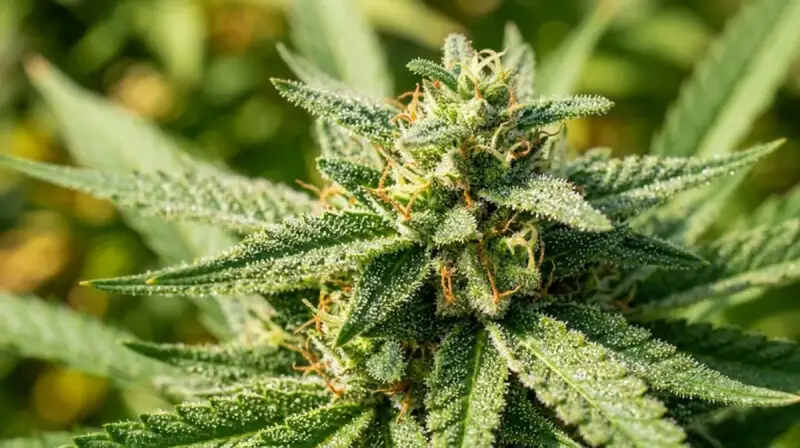
- THC: 15–19%
- CBD: <1%
- Type: Sativa-dominant Hybrid (~70% sativa / 30% indica)
- Flavors: Classic skunk, earthy pine, subtle sweetness, herbal sage note
- Effects: Uplifting cerebral energy, creative focus, mood elevation, mild physical ease
- Grow Difficulty: Easy — vigorous, forgiving, excellent outdoor performer
- Dominant Terpenes: Myrcene, Caryophyllene, Limonene, Pinene
What Is Mendocino Skunk?
Mendocino Skunk is a sativa-dominant strain that connects two of the most significant chapters in American cannabis history: the Emerald Triangle growing tradition of Northern California and the pioneering European cannabis breeding that produced the original Skunk genetics in the 1970s and early 1980s. The cross of Mendocino landrace genetics with classic Skunk produces a strain that honors both lineages — the terpene complexity and sativa structure of Mendocino county’s legendary cannabis terroir combined with the accessible potency, vigorous growth, and unmistakable aroma of the Skunk family.
Mendocino County is the southern vertex of California’s Emerald Triangle, the three-county region (Humboldt, Mendocino, Trinity) that produced some of the most celebrated outdoor cannabis genetics in American history. The region’s unique combination of Mediterranean coastal climate, rich volcanic soil, and generations of dedicated growers working in an environment that rewarded quality over quantity created landrace-adjacent cannabis strains with complex terpene profiles shaped by their specific growing environment. “Mendo” genetics became synonymous with quality in the pre-legalization cannabis market, commanding premium prices and developing a reputation that has persisted through legalization and market commoditization.
The Skunk genetics that form the other half of Mendocino Skunk trace their origins to the foundational work of the Sacred Seeds collective in the late 1970s and early 1980s. The original Skunk #1 was developed from a cross of Colombian Gold, Acapulco Gold, and Afghani genetics — bringing together potent South American sativa energy, earthy Central American flavor, and indica structure from the Hindu Kush mountains. The result was a vigorous, adaptable hybrid with a characteristic musky, skunky aroma that became one of the most widely distributed and influential cannabis genetics in history. Virtually every major European cannabis strain of the following decades carries Skunk genetics in some form.
The combination of Mendocino landrace and Skunk genetics produces a plant that grows with exceptional vigor, adapts well to outdoor cultivation, and expresses a flavor profile that blends the complex, herbal-pine character of Northern California cannabis with the pungent skunky earthiness of the Skunk line. For connoisseurs who appreciate classic cannabis flavors over the sweet dessert profiles that dominate the modern market, Mendocino Skunk is a deeply satisfying connection to the roots of American cannabis culture.
Cannabinoid & Terpene Profile
Mendocino Skunk’s cannabinoid and terpene profile reflects its landrace-Skunk heritage: moderate THC in the 15–19% range with a complex, multi-terpene profile that produces a nuanced effect beyond its raw potency numbers:
| Compound | Typical Range | Effect Contribution |
|---|---|---|
| THC (Delta-9) | 15–19% | Uplifting cerebral euphoria, functional daytime potency |
| CBD | <1% | Mild modulation of THC effects; slightly more balanced experience |
| CBG | 0.3–0.6% | Focus enhancement, anti-inflammatory |
| Myrcene | 0.40–0.70% | Dominant skunky-musky base aroma; mild sedation support; BBB permeability |
| Caryophyllene | 0.30–0.55% | Spicy-pepper note, CB2 anti-inflammatory, stress relief |
| Limonene | 0.20–0.40% | Citrus brightness, mood elevation, anxiolytic |
| Alpha-Pinene | 0.18–0.38% | Pine sharpness; bronchodilator; memory and alertness support |
| Ocimene | 0.10–0.25% | Sweet herbal freshness; Mendocino landrace contribution |
Effects & Experience
Mendocino Skunk delivers what experienced cannabis consumers describe as a “classic high” — the kind of experience that characterized cannabis before the potency arms race of the 2010s and 2020s. At 15–19% THC, it occupies a comfortable middle ground: potent enough to produce genuine, notable effects, but not so intense that it becomes unmanageable for less-experienced users or overwhelming for those seeking function over sedation.
The onset is slightly slower than higher-THC hybrids, arriving within 5–8 minutes of smoking. The initial sensation is a gentle but clear cerebral uplift — a brightening of mood and an opening of perspective that is genuinely sativa in character. Creativity activates, conversation flows more easily, and the environment seems more interesting and worth engaging with. This is the Mendocino landrace genetics expressing themselves: the kind of thoughtful, expansive headspace that Northern California cannabis has been celebrated for across generations of growers and consumers.
The Skunk genetics contribute a physical ease and body warmth that accompanies the cerebral uplift without overwhelming it. This is not a couch-lock or sedation — it is a comfortable, relaxed physical ease that makes movement pleasant and removes tension without impairing it. Most users can remain fully functional throughout the Mendocino Skunk experience, making it suitable for hiking, creative projects, social gatherings, or simply appreciating music and art with heightened sensitivity and focus.
The experience is notably stable compared to higher-THC strains — there are no sudden shifts between phases or dramatic escalations that can catch users off guard. Mood remains positive throughout, creative engagement is sustained, and the body remains comfortable without becoming heavy. Total duration is 2–3 hours at normal doses. This predictability is part of what makes Mendocino Skunk valued: users know what they are getting, and they get it consistently. Anxiety and paranoia are rare at normal doses, even for relatively inexperienced users.
Flavor & Aroma Profile
The aroma of Mendocino Skunk is immediately recognizable to anyone familiar with classic cannabis before the dessert-strain era. It is earthy, pungent, and distinctly skunky — the musky, almost sulfuric base note that gives Skunk genetics their name — layered over a bright pine sharpness from the alpha-pinene content and an herbal complexity that hints at the Mendocino terroir. There is nothing subtle about this aroma: it is assertive, clean, and deeply evocative of a particular era and tradition in cannabis culture.
On the smoke, the earthy skunk character leads but is less intense than the raw bud aroma suggests. The pine becomes more prominent on the inhale, brightening the profile and preventing it from being purely musky. A subtle sweetness threads through the mid-smoke — a quality from the Mendocino landrace genetics that adds an unexpected delicacy to an otherwise robust flavor. The limonene contributes a faint citrus note on the exhale, lightening the finish and leaving a clean, pleasant aftertaste without the heavy earthiness one might expect.
Vaporizing at 170–185°C extracts the lighter terpenes most effectively, emphasizing the pine and citrus notes over the heavier skunky earthiness. At higher temperatures, the full musky-earthy character is most apparent. Hash made from Mendocino Skunk is particularly true to the strain’s character — the terpene profile is amplified in traditional solventless extraction formats, producing a hash with the classic Northern California character that commands respect among experienced consumers who value authenticity over novelty.
Medical & Therapeutic Uses
Mendocino Skunk’s moderate THC level and sativa-dominant profile make it well-suited for daytime medical use where function must be maintained:
Growing Mendocino Skunk
Mendocino Skunk is one of the more grower-friendly strains covered in this guide. The combination of Skunk vigour and Mendocino landrace adaptation produces a plant that is tolerant of minor environmental inconsistencies, responds well to a wide range of growing methods, and produces reliable yields without demanding expert-level cultivation skills.
- Flowering: 63–77 days (9–11 weeks)
- Yield: 500–650 g/m² under 600W HPS or equivalent LED
- Temperature: 70–85°F veg; 65–80°F flower
- Humidity: 55–70% veg; 45–55% flower; wider tolerance than dense indica phenotypes
- Height: 120–160cm indoor; training essential to manage sativa stretch
- SCROG works excellently with the open bud structure of this sativa-dominant strain
- Harvest: mid-October to early November in Northern Hemisphere
- Yield: 800g–1.2kg per plant in optimal full-sun conditions
- Height: 180–280cm; large outdoor plants need adequate space and staking
- Climate: Mediterranean ideal; handles coastal fog and humidity better than dense indicas
- Excellent pest and mold resistance from landrace adaptation
- One of the best producers for outdoor grows in Northern California’s climate
Mendocino Skunk is a particularly rewarding outdoor strain for growers in cooler coastal climates where many dense indica hybrids struggle. The Mendocino landrace genetics evolved in exactly this environment — warm days, cool foggy nights, coastal humidity — and the resulting plant expresses a climate tolerance that premium modern hybrids often lack. Outdoor grows in Northern California, Oregon, or similar climates consistently produce exceptional flower from Mendocino Skunk without the specialized environmental controls needed for more delicate genetics.
The longer flowering time of sativa-dominant strains like Mendocino Skunk (9–11 weeks) rewards patience. Harvesting too early produces a racy, anxiety-prone effect and underdeveloped terpene character. The strain’s full terpene complexity — the herbal, piney, skunky depth that makes it distinctive — does not fully develop until the final 1–2 weeks of flowering. A jeweler’s loupe or digital microscope is recommended to assess trichome maturity: harvest at mostly cloudy trichomes with 5–10% amber for the best balance of energy and relaxation.
Organic growing methods suit Mendocino Skunk particularly well. The landrace genetics respond to rich, biologically active soil in a way that synthetic nutrient programs do not replicate. Growing in well-amended living soil (compost, worm castings, kelp, mycorrhizae) consistently produces more complex, interesting terpene profiles than salt-based hydroponic systems. This is a strain where the growing medium is part of the final flavor expression — a connection to the terroir tradition of Mendocino County itself.
Consumption Methods
Similar Strains
- Skunk #1 — Direct parent genetics; the original skunk strain, less sativa emphasis than Mendocino Skunk
- Mendocino Purps — Related Mendocino genetics; sweeter, grape profile with similar regional heritage
- Super Skunk — Skunk #1 x Afghani; heavier indica contribution, similar skunky aroma foundation
- Trainwreck — Another Northern California sativa legend; similar cerebral energy, more intense potency
- Acapulco Gold — Skunk ancestor genetics; classic sativa energy, similar earthy-complex character