









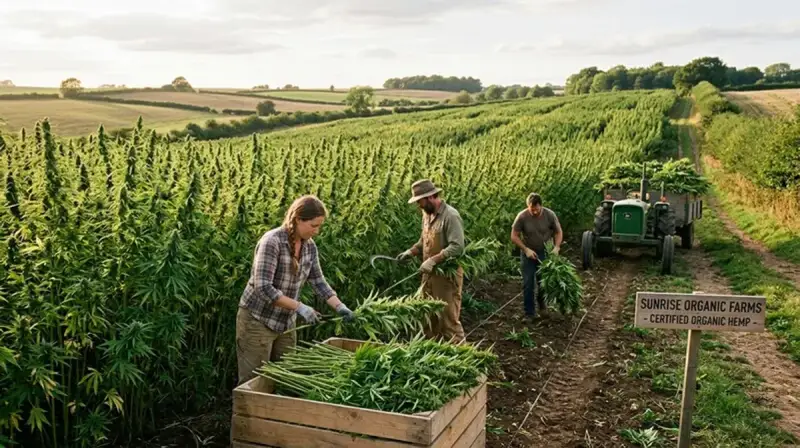
Highest Yielding Cannabis Strains: What Growers & Consumers Need to Know in 2024
ZenWeedGuide Editorial Team |
Updated November 2024 • By the ZenWeedGuide Editorial Team
- Yield is measured in grams per square meter (indoor) or grams per plant (outdoor), and varies enormously by genetics, environment, and technique.
- The highest-yielding strains include Critical Mass, Big Bud, Blue Dream, Auto Critical+, and certain high-performance hybrids developed specifically for large harvests.
- Indoor champions regularly produce 500–800 g/m²; outdoor giants can exceed 1,500g per plant under ideal climate conditions.
- Yield and THC potency are separate genetic traits — the biggest harvests don't always mean the strongest flower.
- Home cultivation is legal for adults in 24 states plus D.C. as of 2024, but plant limits, canopy restrictions, and zoning rules vary widely — always check your state's laws.
- Commercial legal cannabis markets generated over $29 billion in US sales in 2023, intensifying breeder competition to develop ever-larger-producing cultivars.
- Auto-flowering genetics have revolutionized high-yield growing, allowing multiple harvests per year regardless of light cycle.
Background: Why Yield Matters in the Cannabis World
For as long as humans have cultivated Cannabis sativa, yield has been a central concern. Whether feeding a subsistence hemp farm in ancient China or maximizing profit in a licensed dispensary grow operation in Colorado, the question of "how much flower can I get from this plant?" has driven breeding decisions for generations. In the modern legal cannabis era, yield has taken on even greater commercial and personal significance.
For home cultivators, yield determines whether a modest grow space can produce enough medicine or recreational flower to last through a season. For licensed commercial growers, every additional gram per square meter translates directly to revenue — and with wholesale flower prices in some markets falling below $500 per pound, efficient, high-yield genetics are not optional. They are a survival strategy.
Understanding what drives yield — and which strains reliably deliver the biggest harvests — requires looking at genetics, growing environment, training techniques, and the interplay between all three. This guide breaks down the science and the market realities behind the highest-yielding cannabis strains available to US growers today.
The genetics behind yield are rooted in the plant's evolutionary history. Cannabis indica landraces from the Hindu Kush developed dense, compact buds as an adaptation to short mountain growing seasons. Sativa varieties from equatorial regions developed long, airy colas suited to humid tropical climates. Modern hybrid breeding has sought to combine the best of both — dense indica bud structure on vigorous sativa-style plants capable of enormous biomass production. Explore more about how cannabis genetics work in our dedicated explainers section.
"The highest-yielding strains of 2024 are the product of decades of careful selection, combining commercial-scale productivity with the terpene profiles and cannabinoid ratios that today's consumers demand."
It's also worth noting that "yield" isn't a single number. Indoor growers typically measure output in grams per square meter of canopy. Outdoor growers focus on grams per plant. Both metrics matter, and elite strains can rank differently depending on which environment they're placed in. A strain like Blue Dream, for example, is a reliable indoor producer but transforms into a true giant outdoors in warm climates — learn more about individual strain profiles on ZenWeedGuide.
Key Developments: Milestones in High-Yield Cannabis Breeding
The pursuit of maximum yield has driven some of the most important moments in modern cannabis breeding history. The following timeline traces key developments from the 1970s to the present day.
| Era / Year | Milestone | Impact on Yield |
|---|---|---|
| 1970s | Seed Banks Emerge in Netherlands | Systematic breeding begins; yield becomes a selectable trait alongside potency |
| 1980 | Big Bud Developed by Sensi Seeds | First commercially marketed strain explicitly bred for maximum indoor yield; sets the template for decades of breeding |
| Late 1980s | High-Pressure Sodium (HPS) Lighting Adopted Widely | Enables growers to push genetics harder; yield records begin climbing dramatically indoors |
| 1990s | Critical Mass & Critical+ Developed | Indica-dominant hybrids capable of producing such heavy colas that branches require staking; become gold standard for yield |
| Early 2000s | Auto-Flowering Genetics Gain Traction | Ruderalis genetics allow light-independent flowering; growers in northern climates can complete multiple harvests per season |
| 2010s | LED Grow Light Technology Matures | Full-spectrum LEDs rival HPS for yield while cutting energy costs 40–60%; opens indoor growing to home cultivators at scale |
| 2012–2016 | State Legalization Waves (CO, WA, OR, NV) | Legal commercial cultivation incentivizes seed companies to compete aggressively on verified yield data |
| 2018 | Farm Bill Legalizes Hemp; CBD Boom Follows | Hemp cultivation pushes yield science into mainstream agriculture; lessons cross-pollinate into THC cannabis breeding |
| 2020–2023 | Cannabis Research Expands Post-Pandemic | University programs in legal states begin publishing peer-reviewed yield data; growers gain access to evidence-based cultivation guidance |
| 2024 | Next-Generation Auto-Flowering Hybrids Launch | Auto strains now approaching photoperiod yields; some producers report 600+ g/m² from auto-flowering cultivars in optimal conditions |

Impact on Consumers: What High-Yield Strains Mean for You
The rise of high-yield cannabis strains has tangible effects on everyday cannabis consumers — not just commercial growers. Understanding these impacts helps consumers make smarter decisions at dispensaries and, where legal, in their home gardens.
Lower Prices at the Dispensary: When licensed cultivators can grow more flower per square foot, their cost-per-gram drops — and in competitive markets, those savings eventually reach consumers. States like Oregon and California, which have seen significant cultivation expansion, have experienced wholesale price drops that have made cannabis dramatically more affordable for consumers over the past five years.
Greater Product Consistency: High-yield strains tend to be well-documented cultivars that have been grown extensively, meaning dispensaries can source them reliably and consumers can expect consistent experiences. When you find a strain you love — like Blue Dream or a Critical cross — odds are good it will be available regularly because it's economically viable for growers to keep producing it.
Home Garden Efficiency: In the 24 states that permit home cultivation, every plant counts. If your state allows six plants, a high-yield strain could mean the difference between a modest personal supply and a full year's worth of flower from the same garden. For medical patients especially — many of whom rely on consistent home harvests for affordable access — strain selection is a critical health decision. Learn more about medical cannabis growing and access options.
Terpene & Effect Considerations: Consumers should note that not all high-yield strains are optimized for aroma or complex effect profiles. Many of the biggest producers were bred with harvest weight as the primary goal, and some sacrifice terpene richness for mass. Savvy consumers pair yield information with terpene profiles and effect data to choose strains that deliver both volume and quality.
Top High-Yield Strains: Data Comparison
The following table summarizes yield data for the most consistently productive cannabis strains available in the US market as of 2024. Note that figures represent optimal-condition estimates; real-world results vary based on grower experience, environment, and technique.
| Strain | Type | Indoor Yield (g/m²) | Outdoor Yield (g/plant) | THC Range | Flower Time |
|---|---|---|---|---|---|
| Critical Mass | Indica-dominant Hybrid | 600–750 | 1,000–1,200 | 19–22% | 6–8 weeks |
| Big Bud | Indica-dominant Hybrid | 500–600 | 800–1,000 | 15–18% | 7–8 weeks |
| Blue Dream | Sativa-dominant Hybrid | 500–600 | 1,000–1,500 | 17–24% | 9–10 weeks |
| White Widow | Balanced Hybrid | 450–500 | 700–900 | 18–25% | 8–9 weeks |
| Auto Critical+ | Auto-flowering Hybrid | 500–650 | 500–700 | 16–20% | 7–9 weeks (auto) |
| Super Silver Haze | Sativa-dominant Hybrid | 450–550 | 1,200–1,500 | 18–23% | 9–11 weeks |
| Northern Lights | Indica | 450–500 | 700–800 | 16–21% | 7–8 weeks |
| Gorilla Glue #4 | Balanced Hybrid | 500–600 | 900–1,100 | 25–28% |