









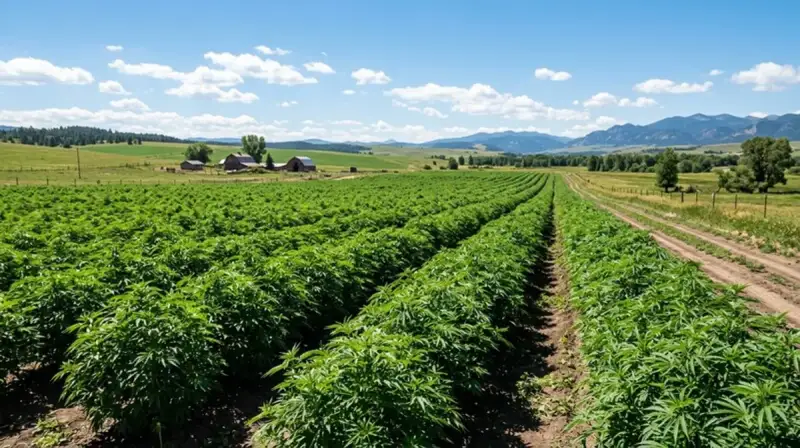
Hemp Biofuel: How Industrial Hemp Is Powering America's Clean Energy Future
ZenWeedGuide Editorial Team |
By ZenWeedGuide Editorial Staff | Cannabis Industry & Policy | Updated 2025
- Industrial hemp can produce both biodiesel (from seed oil) and cellulosic ethanol (from stalks and leaves), making it a dual-purpose biofuel crop.
- The 2018 Farm Bill federally legalized industrial hemp cultivation (under 0.3% THC), dramatically accelerating US biofuel research and production.
- Hemp yields an estimated 207–363 gallons of ethanol per acre, outpacing many traditional biofuel crops in energy density per acre.
- Hemp requires 50% less water than cotton and can be grown without synthetic pesticides in many climates, lowering its environmental footprint.
- Over 47 US states now permit some form of industrial hemp cultivation, creating a nationwide agricultural base for biofuel feedstock.
- For consumers, hemp biofuel development signals lower fuel costs, rural economic growth, and reduced dependence on fossil fuels.
- Hemp's rapid growth cycle — reaching maturity in 70–110 days — allows multiple harvests per year in suitable climates.
Background: Why Hemp Biofuel Matters Now
The intersection of cannabis policy, agricultural innovation, and clean energy has produced one of the most promising — and underreported — developments in the modern renewable energy landscape: hemp biofuel. Industrial hemp, the non-intoxicating cousin of marijuana cannabis plants, has been cultivated for thousands of years for fiber, food, and medicine. But its potential as a biofuel feedstock is only now being fully realized, thanks to a combination of favorable federal legislation, advancing extraction technology, and urgent demand for fossil fuel alternatives.
Hemp (Cannabis sativa L.) is genetically identical to marijuana in species classification, but legally and functionally distinct. Under US federal law as codified by the 2018 Farm Bill, industrial hemp must contain no more than 0.3% tetrahydrocannabinol (THC) by dry weight. This threshold separates it from regulated cannabis strains grown for medical and recreational purposes. The practical consequence: hemp can be grown legally by licensed farmers in most states, opening a vast new agricultural sector.
Why does this matter for energy? Hemp is among the fastest-growing plants on Earth, capable of reaching harvest maturity in as few as 70 days. It produces exceptional biomass — both seed-rich flower heads and dense cellulosic stalks — that can be processed into biodiesel and ethanol respectively. Unlike corn, the dominant US ethanol feedstock, hemp doesn't compete with food supplies and actually improves soil health through phytoremediation. Unlike petroleum, burning hemp biofuel releases only the CO2 the plant absorbed during growth, creating a near-carbon-neutral energy cycle.
The United States consumed approximately 142 billion gallons of gasoline in 2023, according to the US Energy Information Administration. Even replacing a modest fraction of that with domestically grown hemp biofuel would represent a significant economic and environmental shift. Understanding hemp biofuel means understanding not just an energy source, but a potential transformation of American agriculture, rural economies, and the nation's carbon footprint simultaneously. Check our explainers section for broader context on hemp's many applications.
"Hemp is perhaps the premier renewable resource on the planet. It can be used to make thousands of products, and its potential as a biofuel feedstock is only beginning to be understood by mainstream energy policy."
Key Developments: A Timeline of Hemp Biofuel Milestones
Hemp biofuel's journey from historical footnote to modern energy contender is shaped by decades of policy shifts, scientific breakthroughs, and changing social attitudes toward cannabis. The following table outlines the most significant milestones in this evolution:
| Year | Milestone | Significance |
|---|---|---|
| 1941 | Henry Ford demonstrates hemp-body car | Ford's vehicle ran on hemp ethanol, proving hemp's fuel viability over 80 years ago |
| 1942 | USDA "Hemp for Victory" campaign | US government encouraged hemp farming; post-war prohibition followed, stalling research |
| 1970 | Controlled Substances Act lumps hemp with marijuana | Federal prohibition halted all US hemp cultivation and biofuel development for decades |
| 1998 | Canada legalizes industrial hemp | Canada becomes a leading hemp research and export nation; US imports surge |
| 2014 | US Farm Bill allows state hemp pilot programs | First legal US hemp cultivation in decades; universities begin biofuel studies |
| 2018 | 2018 Farm Bill fully legalizes US industrial hemp | Landmark federal law removes hemp from Schedule I; nationwide cultivation begins |
| 2020 | USDA finalizes hemp production regulations | Clear federal framework enables large-scale commercial hemp farming across most states |
| 2021–2022 | Multiple university studies confirm hemp biodiesel viability | Peer-reviewed research validates hemp seed oil as high-quality biodiesel feedstock |
| 2023 | Department of Energy includes hemp in biofuel funding discussions | Federal recognition of hemp's bioenergy potential spurs private investment |
| 2024–2025 | Commercial hemp biofuel pilot projects launch in multiple states | Real-world production testing brings hemp fuel closer to mainstream commercial availability |

Impact on Consumers: What Hemp Biofuel Means for Everyday Americans
For most Americans, the phrase "hemp biofuel" might seem abstract — a laboratory concept rather than something that touches daily life. But the downstream effects of a mature hemp biofuel industry would be felt across multiple dimensions of consumer experience, from fuel prices to food costs to the health of rural communities.
Energy Costs: The most direct consumer impact is at the pump. As hemp biofuel production scales, blending hemp-derived biodiesel with conventional diesel — or hemp ethanol with gasoline — increases fuel supply and competition, which typically moderates retail prices. Biodiesel blends are already used in commercial trucking and agricultural equipment, meaning cost savings often appear first in transported goods and food prices before reaching passenger vehicles.
Air Quality: Hemp biodiesel burns cleaner than petroleum diesel, producing significantly lower emissions of particulate matter, carbon monoxide, and unburned hydrocarbons. For consumers in urban areas or near major freight corridors, wider adoption of hemp biodiesel in trucking fleets would translate to measurable improvements in local air quality. This is especially relevant for communities near ports, distribution centers, and agricultural regions.
Rural Economic Ripple Effects: Hemp biofuel cultivation creates agricultural jobs in regions hit hard by the decline of traditional crops like tobacco. States such as Kentucky, Tennessee, and the Carolinas — which have existing hemp cultivation programs you can explore in our state-by-state cannabis guide — stand to benefit enormously from a hemp biofuel industry that adds value to farm output beyond CBD and fiber products.
Food Supply Independence: Unlike corn ethanol, which diverts a significant portion of America's food grain supply to energy production, hemp biofuel uses the same crop for both food-grade seed oil (used in cooking and nutrition) and biofuel production, with stalk material processed separately for ethanol. This reduces the food-vs-fuel competition that has historically raised corn prices and complicated US agricultural policy.
Consumers interested in the broader cannabis industry should note that hemp biofuel development is entirely separate from the medical and recreational cannabis markets. It does not affect drug testing policies for employees, as industrial hemp biofuel contains no THC and its use as a fuel produces no psychoactive exposure. Our explainers section breaks down the legal distinctions between hemp and marijuana in greater detail.
Industry Perspective: Market Implications and Business Opportunities

The business case for hemp biofuel is compelling across multiple sectors — agriculture, energy, transportation, and manufacturing. The market opportunity is not merely theoretical: several well-capitalized companies and agricultural cooperatives are already positioning themselves to capture early-mover advantages in what analysts project could become a multi-billion-dollar industry within this decade.
| Biofuel Feedstock | Gallons of Ethanol per Acre | Water Requirements | Pesticide Dependency | Soil Impact |
|---|---|---|---|---|
| Hemp | 207–363 | Low–Moderate | Very Low | Improves (phytoremediation) |
| Corn | 370–420 | High | Very High | Depletes |
| Sugarcane | 600–800 | Very High | Moderate | Moderate Depletion |
| Switchgrass | 300–400 | Low | Very Low | Neutral–Positive |
| Soybean | 60–70 (biodiesel) | Moderate | Moderate | Moderate Depletion |
From an investment standpoint, hemp biofuel sits at the intersection of two of the hottest sectors in American business: cannabis and clean energy. Venture capital firms that have been …