









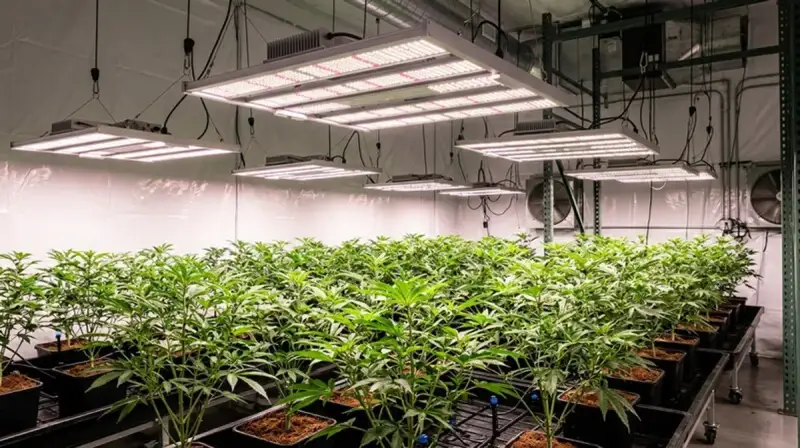
Cannabis Cultivation Innovations: How Science Is Transforming the Way America Grows
ZenWeedGuide Editorial Team |
Analysis & Explainer | ZenWeedGuide Staff | Updated 2025
- Cannabis cultivation technology is advancing faster than at any point in the plant's commercial history, driven by legalization across 38+ US states and intensifying market competition.
- LED lighting, controlled environment agriculture (CEA), AI-driven grow management, and precision genetics are the four dominant innovation pillars reshaping the industry.
- Biosynthesis startups are producing rare cannabinoids like CBG, CBN, and THCV via yeast fermentation — no plant required.
- Sustainable cultivation practices are reducing water use by up to 90% compared to outdoor growing in water-stressed regions.
- For consumers, these innovations mean more consistent potency, broader strain selection, lower prices over time, and safer products with fewer contaminants.
- Cannabis laws vary significantly by state — always check your local state laws before growing, purchasing, or consuming cannabis.
Background: How Cannabis Cultivation Got Its Technological Awakening
For most of cannabis's modern history in America, cultivation was a clandestine affair — basement grows under hot, inefficient high-pressure sodium bulbs, guerrilla outdoor plots hidden from law enforcement, and strain selection driven by luck rather than science. The genetics that circulated in the underground market were often mislabeled, inconsistent, or entirely anonymous. Quality control was non-existent. What consumers received was a roll of the dice.
Everything changed with legalization. When Colorado and Washington became the first states to legalize adult-use cannabis in 2012, they also created the first regulated commercial cannabis cultivation market in the United States. Suddenly, cultivators needed to meet state-mandated testing standards, obtain licenses, pay taxes, and compete on quality in a legal marketplace. The pressure to professionalize was immediate — and it brought in capital, scientists, and technology entrepreneurs who saw a multi-billion-dollar agricultural sector operating with 1970s-era techniques.
The infusion of agricultural technology (AgTech) expertise has been transformational. Companies that previously developed controlled environment agriculture systems for lettuce and tomatoes pivoted to cannabis. Semiconductor companies began engineering purpose-built LED arrays for the plant's specific photosynthetic needs. Genomics firms started sequencing cannabis DNA at scale. Venture capital poured in. By 2020, the legal US cannabis cultivation market had become one of the most technologically dynamic agricultural sectors in the country — a remarkable turnaround for a plant that federal prohibition had locked out of university research programs for decades.
Understanding this innovation wave matters for everyone in the cannabis ecosystem — consumers, patients, investors, and policymakers alike. The technology being deployed today will define the quality, safety, and cost of cannabis products for the next generation.
Key Developments: A Timeline of Cannabis Cultivation Innovation
The pace of change in cannabis cultivation technology has been extraordinary. Below is a chronological overview of the milestones that have most significantly shaped the modern grow room and cultivation landscape.
| Year | Milestone | Significance |
|---|---|---|
| 2012 | Colorado & Washington legalize adult-use cannabis | Creates first regulated commercial cultivation market; forces professionalization |
| 2014 | First purpose-built cannabis LED grow lights reach market | Begins transition away from energy-intensive HPS lighting |
| 2016 | DEA permits more federally authorized cannabis research | Opens door to university-level cultivation science |
| 2017 | Phylos Bioscience launches large-scale cannabis genome sequencing | Maps genetic relationships among 800+ strains; enables marker-assisted breeding |
| 2018 | Hemp legalized under the 2018 Farm Bill | Unlocks agricultural research and CBD cultivation at scale nationally |
| 2019 | Demetrix raises $50M for cannabinoid biosynthesis via yeast | Validates precision fermentation as viable cannabinoid production pathway |
| 2020 | AI-driven grow management platforms launch commercially | Real-time environmental monitoring, yield prediction, and automated nutrient dosing |
| 2021 | Tissue culture propagation adopted by large multi-state operators | Disease-free, genetically identical mother plants; eliminates contamination risk |
| 2022 | Aeroponic and hydroponic hybrid systems achieve record yields | Some facilities report 30–40% yield improvements over soil grows |
| 2023–2025 | CRISPR gene editing research expands to cannabis | Potential to enhance disease resistance, cannabinoid expression, and terpene profiles |

Each of these milestones represents a compounding effect. LED lighting lowered energy costs, making indoor cultivation economically viable for more operators. Genome sequencing gave breeders scientific tools to develop purpose-built strains rather than relying on chance. AI platforms connected all of these inputs into unified management dashboards. The result is a cultivation industry that, at its leading edge, more closely resembles a pharmaceutical manufacturing operation than a traditional farm.
Impact on Consumers: What Innovation Means at the Dispensary Counter
For the cannabis consumer, all of this technology ultimately shows up in three tangible ways: consistency, safety, and product diversity.
Consistency has historically been one of cannabis's biggest challenges. Because the plant's cannabinoid and terpene expression is heavily influenced by growing conditions, two batches of the same strain from the same cultivator could produce noticeably different effects. Advanced CEA systems — precisely controlling temperature, humidity, CO₂ levels, light spectra, and nutrient delivery — have made it possible to reproduce growing conditions with near-pharmaceutical precision across every crop cycle. Consumers buying a favorite strain from a licensed dispensary can now expect much greater batch-to-batch reliability than was possible five years ago.
Safety has improved dramatically as cultivation innovation intersects with regulatory compliance. Integrated pest management (IPM) systems, tissue culture propagation, and water-recirculating hydroponic setups all reduce or eliminate the need for chemical pesticide applications. State-mandated testing — now routine across all major legal markets — screens for pesticide residues, mold, heavy metals, and microbial contamination. The combination of cleaner growing practices and rigorous third-party testing means legal cannabis products are among the most thoroughly tested consumer agricultural goods in the United States.
Product diversity is perhaps the most exciting consumer-facing outcome of cultivation innovation. Genomic breeding programs are producing strains with targeted cannabinoid profiles — high-CBD strains for daytime wellness, balanced THC:CBD formulations for moderate effects, strains rich in rare cannabinoids like CBG or THCV that were virtually unavailable commercially a decade ago. The terpene science revolution has also enabled cultivators to breed for specific aromatic and flavor profiles, giving consumers a far more sophisticated and personalized selection than the simple indica/sativa binary of the past.
Price is another long-term beneficiary. As cultivation efficiency improves and yields increase, the cost per gram of producing quality cannabis has been declining in mature legal markets. In states like Oregon and Colorado, wholesale cannabis prices have dropped significantly since peak prohibition-era highs, and while retail pricing involves many other factors, the trajectory of cultivation efficiency points toward more affordable legal cannabis over time.
Industry Perspective: The Business of Better Growing

From a market perspective, cannabis cultivation technology represents one of the sector's most compelling investment stories. The convergence of AgTech, biotech, and cannabis has attracted capital from venture firms, agricultural conglomerates, and pharmaceutical companies who see the regulatory trend lines pointing toward a fully federally legal US market in the coming years.
Multi-state operators (MSOs) — companies like Curaleaf, Green Thumb Industries, and Trulieve — have invested heavily in standardizing cultivation protocols across their facilities, treating growing operations with the same rigorous quality management systems applied in food manufacturing. This institutional approach to cultivation has raised the bar for the entire industry.
Meanwhile, technology vendors serving the cannabis cultivation space have built substantial businesses. Companies like Agrify, Fluence (a Signify company), and Growlink provide integrated cultivation technology platforms. The cannabis-specific AgTech market is projected to reach $7.1 billion by 2028, according to industry analysts, reflecting both the scale of existing legal cultivation and the anticipated expansion as more states legalize and federal reform advances.
| Technology Category | Key Players | Primary Benefit | Estimated Adoption Rate |
|---|---|---|---|
| LED Lighting Systems | Fluence, Gavita, HLG | 40–50% energy reduction vs. HPS | ~60% of licensed indoor facilities |
| AI Grow Management | Agrify, Growlink, Trym | Real-time optimization, yield prediction | ~25% of commercial operators |
| Tissue Culture Propagation | PhytoMedical, in-house R&D | Disease-free, genetically uniform clones | ~15% of large MSOs |
| Hydroponic / Aeroponic CEA | Various, often custom-built | 30–40% yield improvement, 90% water savings | ~45% of indoor facilities |
| Cannabinoid Biosynthesis | Demetrix, Amyris, Librede | Rare cannabinoid production without the plant | Early commercial stage |
| Genomic Breeding Tools | Phylos Bioscience, Steep Hill | Faster, more precise strain development | ~20% of licensed cultivators |
The sustainability angle is increasingly important to both investors and consumers. Cannabis cultivation — particularly large-scale indoor growing — has historically been an energy-intensive enterprise. A landmark study from the University of California, Davis estimated that US indoor cannabis production generates approximately 15 million metric tons of CO₂ equivalent annually. The industry's adoption of LED lighting, renewable…