










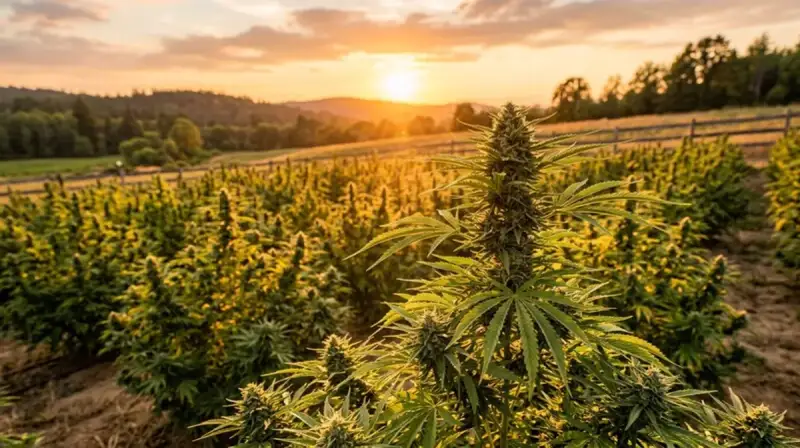
- Mainlining creates a symmetrical manifold by topping at node 3 and training two main colas
- The technique produces even canopy, uniform bud sites, and efficient light use
- A full mainline with 8 colas takes 2–3 additional weeks of veg compared to no training
- Photoperiod strains are better suited to mainlining than autoflowers
- Proper topping angle and healing time between steps prevent stress and stunting
Introduction to Cannabis Mainlining Technique
Cannabis mainlining is a high-stress training (HST) technique that combines topping, low-stress training (LST), and selective defoliation to build a symmetrical, hub-and-spoke plant structure known as a "manifold." First popularized by grower Nugbuckets in the early 2010s, the method has become a favorite among indoor cultivators chasing maximum yield per watt and a perfectly flat canopy. Rather than letting a plant grow naturally with one dominant cola surrounded by smaller side branches, mainlining transforms it into an even array of identical main colas — typically eight — each receiving the same intensity of light from above.
The principle is simple but the execution requires patience: every main branch on a mainlined plant traces back to a single node on the main stem, splitting the plant's nutrient and hormone flow equally between each cola. The result is a uniform "candelabra" of buds that ripen at the same time, fatten to comparable sizes, and waste almost no energy on weak undergrowth. This guide walks you through the entire mainlining process from seedling to flip, with timelines, tools, common pitfalls, and strain recommendations to help you build a clean manifold on your first attempt.
What Is a Cannabis Manifold?
A manifold, in mainlining terminology, is the Y-shaped junction created when you top the plant cleanly at the third node and remove everything below it. That single junction becomes the "hub" from which every future branch emerges. By training those two remaining stems horizontally and topping them again, the grower doubles the number of colas at each round: 2, then 4, then 8, then 16. Most home growers stop at 8 because it provides the best balance of yield, light penetration, and manageability inside a standard 4×4 or 5×5 tent.
Why Mainline Instead of Just Topping?
Standard topping creates two or more colas but the plant's natural branching pattern is rarely symmetrical — one side almost always outpaces the other due to apical dominance. Mainlining solves this by stripping the lower growth so the plant cannot divert energy unevenly. Every cola in a finished manifold is at the same height, the same age, and receives the same flow of sap, which is why mainlined plants produce uniform bud size at harvest.
Mainlining vs. Other Training Methods
Mainlining is often confused with related techniques, but each has distinct goals and stress levels:
| Technique | Stress Level | Goal | Added Veg Time |
|---|---|---|---|
| Mainlining | High | Symmetrical 8-cola manifold | 2–3 weeks |
| Topping | Medium | Multiple colas | 7–10 days |
| LST | Low | Flat canopy | 0–7 days |
| ScrOG | Low–Medium | Net-filled canopy | 1–2 weeks |
| FIM | Medium | 3–4 colas from one cut | 5–7 days |
Tools You Need Before Starting
Mainlining is a precision technique, and clean tools dramatically reduce infection risk after each cut. Before you make your first snip, gather the following:
- Sharp, sterilized pruning shears or trimming scissors — wipe with isopropyl alcohol before every cut
- Soft plant ties or coated wire — never use bare wire, which cuts into stems
- Anchor points — fabric pots with grommets, bamboo stakes, or a SCROG-style frame
- A photoperiod cannabis plant in a container of at least 3–5 gallons
- Healthy growing environment with stable temps (22–26°C) and 18/6 light cycle
Step-by-Step Mainlining Guide
Step 1: Grow to the 5th–6th Node
Begin from seed or clone and grow the plant under 18/6 until it has developed five to six true nodes. This usually takes 3–4 weeks. The stem should be sturdy enough that the lower section near node three has begun to harden slightly. If the plant is still floppy and pale, wait another week — strong cell-wall structure is critical to surviving the first topping.
Step 2: Top Above the Third Node
Locate the third node from the soil (count from the lowest set of true leaves upward, ignoring the cotyledons). Using sterilized scissors, cut the main stem cleanly just above this node. You're removing nodes 4, 5, 6, and the apical tip. This single cut is what creates the manifold "hub." The remaining plant should look short and almost cruel — that's correct.
Step 3: Strip Everything Below the Manifold
Carefully remove all growth at nodes 1 and 2 — branches, leaves, and any minor side shoots. The only growth points left on the plant should be the two branches emerging from node 3. This forces 100% of the plant's energy into building two symmetrical mains. Don't worry about the bare lower stem; it improves airflow and prevents pests.
Step 4: Tie Down the Two Mains Horizontally
Using soft ties, gently bend each of the two branches outward at roughly 90 degrees from the main stem, forming a flat "Y." Anchor them to the rim of the pot or to stakes. The growing tips should be lower than — or level with — the manifold junction. This bending forces the plant into a stretching response, sending hormones equally to both branches.
Step 5: Recovery and Growth (7–10 days)
Let the plant heal and resume vigorous growth. Each of the two mains will develop several new nodes during this period. Maintain consistent watering and mild nutrient levels — this is not the time to push high feed. You'll see new vertical shoots emerging from each node on the trained branches. Wait until those shoots have 3–4 nodes each before the next topping round.
Step 6: Top Each Branch Above the Third Node Again
Repeat the topping principle on both mains. Count three nodes out from the manifold along each branch, then top each one just above that third node. Strip the inner shoots so only the two outermost growth points remain on each branch. You now have four main growth tips, all at the same height. This is your 4-cola stage.
Step 7: Top Once More for an 8-Cola Manifold
After another 7–10 days of recovery, repeat the topping process one final time on each of the four mains. Each branch is again topped above its third node, leaving two new growth tips per branch — for a total of eight evenly spaced colas. Tie everything down horizontally so the canopy is perfectly flat.
Step 8: Final Veg and Flip to Flower
Continue tying the eight branches outward in a starburst or "wagon-wheel" pattern. Once each cola has stretched 6–10 inches above the canopy and the plant is bushy but still even, switch your lights to 12/12 to initiate flowering. Flowering stretch will roughly double the height of each cola, so flip earlier than you think.
Mainlining Timeline at a Glance
| Week | Stage | Action |
|---|---|---|
| 1–3 | Seedling / early veg | Grow to 5–6 nodes |
| 4 | First topping | Cut above node 3, strip lower growth |
| 5 | Recovery | Tie down 2 mains horizontally |
| 6 | Second topping | Top to 4 colas |
| 7 | Third topping | Top to 8 colas |
| 8–9 | Final veg | Even canopy, flip to 12/12 |
| 10–17 | Flower | 8 uniform colas fatten and ripen |
Pros and Cons of Mainlining
Mainlining is powerful but not universally ideal. Understanding the trade-offs helps you decide if it suits your setup.
Pros
- Highly uniform colas — every bud site finishes at roughly the same size and density
- Excellent light penetration with no shaded lower branches wasting energy
- Flat canopy maximizes use of a fixed-area LED footprint
- Easier trimming because there's almost no popcorn bud
- Predictable yields once you've run a strain through the technique
Cons
- Adds 2–3 weeks of vegetative time
- Requires sterile tools and careful technique to avoid infection
- Not suitable for autoflowers — fixed life cycle leaves no recovery window
- Mistakes are visible: an asymmetrical manifold cannot easily be fixed
- Sativa-leaning strains with long internodes may stretch unevenly
Best Strains for Mainlining
Indica-dominant and balanced hybrids with tight internodes and sturdy stems respond best to mainlining. Long-stretch sativas can still be mainlined, but they require more aggressive bending and a much earlier flip. Recommended strain profiles include:
- Northern Lights — short, bushy, forgiving — ideal for first-time mainliners
- Blueberry — strong lateral branching and easy to bend
- Critical Mass — heavy yielder that thrives on HST
- Gorilla Glue #4 — sturdy stems handle multiple toppings without snapping
- Wedding Cake — uniform structure, dense colas, great mainline candidate
- OG Kush — slow but rewarding response to manifold training
Avoid ultra-fast autoflowers and runty phenos. The technique punishes weak genetics because the plant has nowhere to hide energy losses.
Common Mistakes to Avoid
- Topping too early — cutting before the plant has 5–6 nodes results in slow recovery and uneven mains
- Topping at the wrong node — counting cotyledons leads to a manifold that's one node too low and prone to snapping
- Not waiting between toppings — stacking cuts before the plant recovers causes severe stunting
- Leaving inner shoots — failing to strip secondary growth from each branch breaks the symmetry
- Using dirty scissors — unsterilized blades can introduce fungal infection into open wounds
- Tying too tight — wire ties cut into stems and choke nutrient flow
- Mainlining an autoflower — almost always results in lost yield because the plant flowers before recovering
- Flipping to flower with uneven mains — once you flip, stretch locks in the asymmetry permanently
After the Flip: Managing a Mainlined Plant in Flower
Once your eight colas have set, the role of training shifts from shaping to maintaining. During the first 2–3 weeks of flower (stretch), continue tucking and bending tall colas back down to keep the canopy level. After stretch slows, lollipop the lower 6–8 inches of each cola — remove any small popcorn shoots, leaving only the main bud sites. This focuses the plant's resources on the eight dominant tops and dramatically improves bud density and trim time at harvest.
Feed levels can be pushed higher than with an untrained plant because the manifold supports vigorous, balanced uptake. Many growers report that mainlined plants finish 2–4 days earlier than the same strain grown naturally, likely due to the uniform ripening of all eight colas at once. Watch trichomes closely and harvest when 20–30% of them have turned amber for a balanced effect.
Frequently Asked Questions
When should I start mainlining my cannabis plant?
Start mainlining once your plant has developed 5 to 6 true nodes, typically 3 to 4 weeks from seed. The plant should have a strong root system and healthy growth before the first topping cut at the third node.
How long does mainlining add to the veg stage?
A full 8-cola mainline adds 2 to 3 weeks to vegetative growth compared to an untrained plant. Each topping round requires 7 to 10 days of recovery before the next cut or training step.
Can you mainline autoflowering strains?
Mainlining autoflowers is risky because their fixed life cycle does not allow enough time to recover from multiple toppings. Photoperiod strains are strongly preferred for this technique.
How many colas should a mainlined plant have?
Most growers aim for 8 colas, achieved by topping each main branch twice after the initial manifold cut. Some experienced growers extend to 16 or 32 colas, but 8 offers the best balance of yield, space, and manageability.