










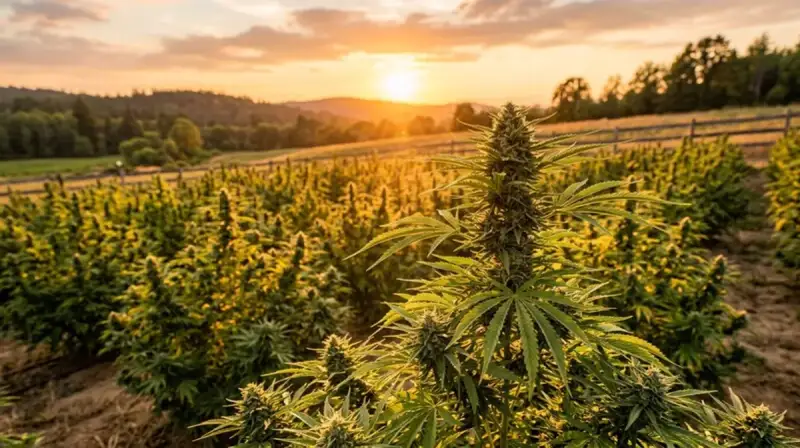
- VPD (Vapour Pressure Deficit) is more accurate than RH alone for optimising plant transpiration
- Seedlings need 65–70% RH; flowering plants need 40–50% to prevent bud rot
- Optimal VPD during flowering: 1.0–1.5 kPa for maximum resin production
- Dehumidifiers are essential in the last 2 weeks of flower to protect dense buds
- Airflow must be continuous — stagnant air multiplies mold risk exponentially
Introduction to Cannabis Humidity and VPD Guide
Humidity is one of the most underestimated variables in cannabis cultivation. Growers obsess over light intensity, nutrient ratios and pH, yet the moisture in the air controls how every one of those inputs actually reaches the plant. When relative humidity (RH) sits in the wrong range, stomata close, transpiration stalls, and nutrient uptake grinds to a halt — no matter how perfect the rest of your setup is. On the other end of the spectrum, excess humidity in late flower is the single largest cause of catastrophic crop losses worldwide, with botrytis (bud rot) capable of destroying weeks of work in 48 hours.
This guide breaks humidity down two ways: the simple RH ranges every grower should hit per stage, and the more advanced concept of Vapour Pressure Deficit (VPD), which combines temperature and humidity into a single number that predicts plant behaviour with far greater accuracy. Whether you're running a 2x2 tent or a sealed commercial flower room, understanding the relationship between air moisture, leaf temperature and transpiration will transform your yields, your terpene profiles, and your mold-prevention strategy.
What Is Relative Humidity and Why It Matters for Cannabis
Relative humidity is the percentage of moisture in the air compared to the maximum the air could hold at that temperature. At 25°C, air at 60% RH holds 60% of its maximum water capacity. As temperature rises, air can hold more moisture, which means the same absolute moisture content reads as a lower RH percentage when the room warms up. This is why RH alone is a misleading metric — and why VPD exists.
For cannabis, RH dictates the rate of transpiration through the leaves. When air is dry, plants pull water (and dissolved nutrients) up through their roots more aggressively to replace what's lost through the stomata. When air is humid, transpiration slows and the plant becomes lazy — it stops drinking, stops feeding, and starts inviting mold. The trick is matching the humidity to the plant's developmental stage.
The Stomata and the Transpiration Engine
Stomata are the microscopic pores on the underside of cannabis leaves that open to exchange CO2 and water vapour. They are exquisitely sensitive to humidity. In overly dry air, they close defensively to prevent dehydration — which also blocks CO2 intake and stalls photosynthesis. In overly humid air, they stay open but the moisture gradient is too weak to drive transpiration. Both extremes reduce growth.
Understanding VPD (Vapour Pressure Deficit)
VPD measures the difference between how much moisture the air can hold and how much it actually holds, expressed in kilopascals (kPa). A low VPD (below 0.4 kPa) means the air is nearly saturated — plants struggle to transpire. A high VPD (above 1.6 kPa) means the air is very thirsty — plants transpire too aggressively and risk wilting or nutrient burn from over-uptake. The sweet spot depends on the growth stage.
The crucial detail most beginners miss: VPD calculations should ideally use leaf temperature, not air temperature. Under LED lights, leaf temperatures often run 2–3°C below ambient because of the lack of infrared heat. Under HPS, leaves can run 1–2°C above ambient. An infrared thermometer pointed at the upper canopy is a cheap, high-value addition to any toolkit.
How to Calculate VPD
The formula is: VPD = SVP(leaf) − (SVP(air) × RH/100), where SVP is saturation vapour pressure at the given temperature. Most growers don't calculate this by hand — they use a VPD chart or a controller that reads sensor data and outputs the value directly. Tools like AC Infinity controllers, TrolMaster, or even free phone apps will give you live VPD readings.
Optimal Humidity and VPD by Growth Stage
The plant's water needs change dramatically across its life. A clone with no roots cannot draw water from the medium and must absorb it through its leaves — so humidity must be very high. A mature flowering plant with a developed root system and dense colas needs dry air to push transpiration and resist mold. Here are the working ranges:
Seedlings and Clones: High Humidity Is Non-Negotiable
Seedlings have minimal root systems and clones have none. Both rely on absorbing water through their leaves until roots develop. Without 65–75% RH (and ideally a humidity dome for clones), they desiccate within hours. Use a propagation tray with a clear lid, mist twice daily, and lift the lid briefly each day to exchange air and prevent fungal growth on the medium surface.
Vegetative Stage: Building Plant Mass
During veg, gradually step humidity down from 65% to 55% as the plant builds roots and leaf mass. This trains the plant to transpire actively and feeds rapid above-ground growth. Higher humidity at this stage is forgiving — vegetative plants are not at mold risk because they have no dense flower clusters.
Flowering: The Critical Phase
From the moment you flip to 12/12, humidity must trend downward week by week. The reasoning is twofold: first, lower humidity drives stronger terpene production as the plant ramps up defensive resin secretion; second, as buds swell and become denser, the internal microclimate of each cola becomes a perfect breeding ground for botrytis if ambient RH is too high.
How to Measure Humidity Accurately
You cannot control what you do not measure. The cheap hygrometer that came with your tent is almost certainly inaccurate by 5–10% — and that margin is the difference between healthy buds and a botrytis outbreak. Invest in a calibrated digital hygrometer with min/max memory, place it at canopy height (not on the floor or ceiling), and keep it away from direct light or fan blast which skews readings.
Calibrating Your Hygrometer
The salt test is the gold standard: place a tablespoon of table salt in a small dish, add a few drops of water to make a slurry (do not dissolve it fully), put the dish and your hygrometer together in a sealed zip-lock bag, and wait 6–8 hours. A correctly calibrated meter should read 75% RH. Adjust accordingly or replace the unit. Cheap meters drift over time, so re-test every 6 months.
Multiple Sensors for Accuracy
Air does not mix uniformly in a grow space. Place one sensor at the top of the canopy, another at floor level, and a third near the exhaust. Differences greater than 8% indicate poor air circulation and a need for additional oscillating fans.
Controlling Humidity: Tools and Techniques
Dehumidifiers
For flowering rooms, a dehumidifier is not optional — it is core equipment. Size it based on the volume of your space and how much water your plants transpire. As a rule of thumb, a flowering plant transpires roughly 1 litre of water per day per 100W of light. A 600W tent with three plants might produce 18 litres of moisture daily. Your dehumidifier needs to handle that load with headroom.
Humidifiers
For veg rooms, propagation, and dry climates, an ultrasonic humidifier with a humidistat is ideal. Avoid evaporative humidifiers in a sealed grow space — they cool the air and create cold spots that condense moisture on leaves, inviting powdery mildew.
Air Circulation and Ventilation
Stagnant air at 50% RH is more dangerous than moving air at 60% RH. Mold spores need still, moist surfaces to germinate. Run oscillating fans 24/7, positioned to rustle leaves gently throughout the canopy. Exhaust fans should be sized to exchange the room's total air volume every 1–3 minutes. Intake air should pass through a carbon or HEPA filter to keep mold spores out.
AC and Climate Control
In sealed rooms, an AC unit doubles as a dehumidifier because cooling air condenses water out of it. Mini-split systems with dedicated dehumidification modes are the standard for serious indoor setups. Coupled with a controller like the Inkbird ITC-308 or a more advanced unit, you can dial in night and day setpoints automatically.
Mold and Bud Rot Prevention
Botrytis cinerea (grey mold, bud rot) thrives at 60%+ RH, 15–25°C, and in still air. It starts inside the densest part of a cola — invisible from the outside — and works outward, turning healthy buds into grey, mushy, spore-puffing horror within days. Prevention is everything; treatment is not really an option once it starts.
Defoliation and Canopy Management
Strip lower fan leaves and crowded foliage during weeks 3 and 5 of flower. The goal is light penetration to lower bud sites and, more importantly, airflow through the canopy. Dense, untended plants grow like sponges holding moisture in the middle.
Daily Inspection in Late Flower
From week 5 onward, inspect every cola daily. Look for single leaves that have suddenly wilted or yellowed in the middle of an otherwise healthy bud — that is the signature of bud rot beginning beneath. Remove the affected bud immediately, cutting well below the visible damage, and dispose of it outside the grow area.
Night-Time Humidity Spikes
When lights go off, room temperature drops, and the same moisture in the air now reads as higher RH. A room at 45% RH lights-on can easily climb to 65% RH lights-off — directly into mold territory. Run your dehumidifier harder during the dark cycle, or program it to a tighter setpoint at night.
Drying and Curing: The Humidity Endgame
After harvest, the principles flip. You want to remove moisture slowly to preserve terpenes and avoid harshness. Dry rooms should sit at 55–62% RH and 15–20°C, with gentle indirect airflow. Drying too fast (low RH, high temp) locks in chlorophyll and creates a hay smell. Drying too slow risks mold on the cut buds. Aim for 7–14 days hang time, then move to jars for curing at 58–62% RH using Boveda or Integra Boost packs to stabilise.
Common Mistakes to Avoid
- Trusting the cheap hygrometer in your tent kit. They are wildly inaccurate. Calibrate or replace.
- Ignoring lights-off humidity. Night-time spikes are when most bud rot starts. Monitor 24/7.
- Running a humidifier in flower. By week 2 of flower you should rarely need to add moisture, only remove it.
- Sealing the tent without exhaust. Stagnant air at 50% RH grows mold faster than ventilated air at 60% RH.
- Misting leaves during flower. Foliar sprays during budding invite powdery mildew and bud rot.
- Ignoring leaf temperature. Under LEDs, leaves run cooler than air — your VPD calculation is off if you only measure ambient.
- Drying too fast. RH below 45% during drying degrades terpenes and produces harsh smoke.
- Not defoliating dense canopies. Trapped humidity inside the bush is invisible until rot appears.
- Skipping the salt test. Six months of drift can put you 10% off without warning.
- Adding plants in late flower without quarantine. New plants can carry mold spores into a clean room.
Advanced: Dialling In VPD for Maximum Yield
Once you have basic RH control, the next jump in quality comes from tightening VPD. Commercial growers chase VPD because it correlates directly with biomass production. A plant transpiring at peak efficiency drinks more, eats more, and grows faster. The technique involves coordinating temperature and humidity together rather than treating them as separate variables. If your room is too humid, you can either dehumidify or warm the air — both will lower VPD's relative effect. If too dry, cool the air or humidify.
In CO2-supplemented rooms, run slightly higher temperatures (28–30°C) and slightly lower humidity to keep VPD in the 1.2–1.5 range while CO2 levels of 1000–1500 ppm push photosynthesis. This combination is the basis of every high-yield commercial cannabis facility on the planet.
Frequently Asked Questions
What is the ideal humidity for flowering cannabis?
During flowering, relative humidity should be kept between 40% and 50%. In the last two weeks before harvest, dropping RH to 35–40% helps protect dense buds from mold and encourages stronger resin production.
What is VPD and why does it matter?
VPD (Vapour Pressure Deficit) measures the difference between the moisture air can hold and the moisture it currently holds, expressed in kPa. It dictates how efficiently plants transpire, take up nutrients, and grow. It is more accurate than RH alone because it accounts for temperature.
How do I prevent bud rot during late flowering?
Maintain RH below 50%, keep continuous airflow over and under the canopy, defoliate dense colas, run a dehumidifier during lights-off, and inspect buds daily. Any browning, wilting tip leaves on a cola should be removed immediately.
Can I grow cannabis without measuring VPD?
Yes, beginners can grow successfully using RH and temperature ranges alone. However, dialling in VPD pushes yields and resin production higher, especially in sealed rooms with CO2 supplementation or LED lighting where leaf temperatures differ from air temperatures.