










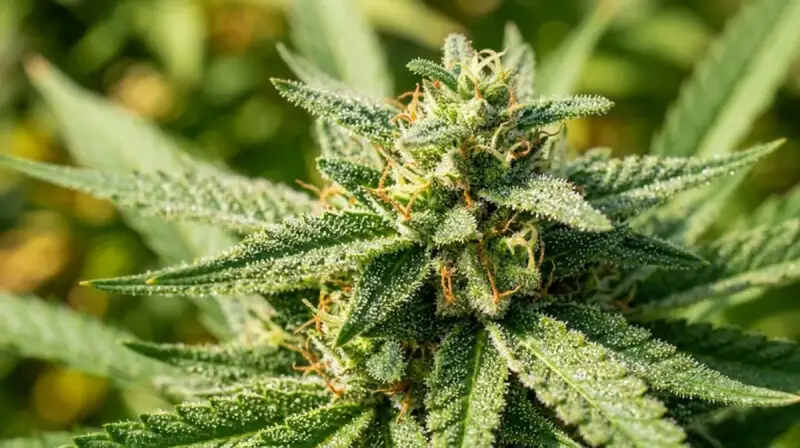
- Delta-9-THC (Δ9-THC) is a partial agonist at CB1 and CB2 receptors — its psychoactive effects result from CB1 activation in the prefrontal cortex, hippocampus, basal ganglia, and cerebellum.
- THC’s biphasic dose-response: low doses (2.5–7.5 mg) reduce anxiety; higher doses (>15 mg) can trigger anxiety, paranoia, and in rare cases acute psychosis.
- THC activates dopamine release in the nucleus accumbens — the same reward pathway as nicotine, alcohol, and other addictive substances, explaining cannabis’s approximately 9% addiction potential.
- THCA (THC-acid) in raw cannabis flower is non-psychoactive — decarboxylation at 105–115°C converts THCA to psychoactive THC; this is why raw cannabis doesn’t produce a high.
- The 2018 Farm Bill created a legal anomaly: hemp-derived delta-8 and delta-10 THC products (from CBD conversion) circulate in a gray market in states where delta-9 is illegal.
- Delta-9-THC is metabolized to 11-OH-THC in the liver — this metabolite is more potent and longer-lasting than delta-9 itself, explaining why edibles feel qualitatively stronger than smoking.
- FDA has approved only one synthetic THC drug: dronabinol (Marinol/Syndros), a Schedule III pharmaceutical, for chemotherapy-induced nausea and HIV wasting syndrome.
Chemical Structure and Pharmacology
Delta-9-tetrahydrocannabinol (delta-9-THC, Δ9-THC) has the molecular formula C21H30O2 and a molecular weight of 314.45 g/mol. Its IUPAC name is (6aR,10aR)-6,6,9-trimethyl-3-pentyl-6a,7,8,10a-tetrahydro-6H-benzo[c]chromen-1-ol. The defining structural feature is a double bond between the 9th and 10th carbon positions on the terpenoid ring — it is this specific geometry that confers CB1 receptor affinity.
CB1 and CB2 Receptor Binding
THC is a partial agonist at both CB1 and CB2 cannabinoid receptors, with higher affinity and functional activity at CB1 (Ki approximately 35–80 nM). Partial agonism means THC activates the receptor but produces less than maximum response compared to endogenous agonists like anandamide — this partial activity is thought to contribute to the ceiling effect on psychoactivity and explains why synthetic full agonists (like JWH-018) are far more dangerous than plant THC. CB1 receptors are among the most densely expressed G-protein coupled receptors in the mammalian brain; CB2 receptors are predominantly peripheral and immune-system associated.
| Cannabinoid | CB1 Affinity (Ki) | CB2 Affinity (Ki) | Psychoactive? | Primary Effect |
|---|---|---|---|---|
| Delta-9-THC | ~35–80 nM (partial agonist) | ~3–75 nM | Yes | Euphoria, appetite, analgesia |
| CBD | Negative allosteric modulator | Weak partial agonist | No | Anxiolytic, anti-inflammatory |
| CBG | Low affinity partial agonist | Moderate partial agonist | No | Antibacterial, neuroprotective |
| CBN | Low partial agonist (~211 nM) | Moderate agonist | Mildly (10% of THC) | Sedating, antibacterial |
| Delta-8-THC | ~44 nM (partial agonist) | Moderate | Yes (50–70% of delta-9) | Similar to delta-9, less potent |
CBD’s Modulating Effect on THC
CBD functions as a negative allosteric modulator at CB1 — it binds to a different site on the receptor than THC and reduces CB1 activity, partially counteracting THC’s psychoactive and anxiety-producing effects. This is the pharmacological basis for CBD:THC ratio-formulated products designed to reduce paranoia and dysphoria at higher THC doses. The modulating effect is dose-dependent and not complete; very high THC doses overwhelm CBD’s moderating influence.
How THC Creates the High
The subjective experience of being “high” from cannabis results from THC’s simultaneous action across multiple brain regions, each contributing different components of the experience.
Brain Regions and Their Contributions
Prefrontal cortex: CB1 activation disrupts normal glutamate and GABA neurotransmission, impairing executive function, working memory, and time perception. This is the region responsible for the characteristic difficulty concentrating and altered sense of time during intoxication.
Hippocampus: THC impairs synaptic plasticity in the hippocampus, disrupting formation of new short-term memories. This explains the memory encoding deficits that make it difficult to follow complex conversations or recall what was just said while acutely intoxicated.
Nucleus accumbens: THC disinhibits dopaminergic neurons in the ventral tegmental area, increasing dopamine release in the nucleus accumbens — the brain’s primary reward center. This produces the euphoric “high” and is the mechanism underlying cannabis’s addiction potential, estimated at approximately 9% for regular adult users (versus 15% for alcohol and 32% for nicotine).
Basal ganglia and cerebellum: CB1 activation in motor-control regions produces the characteristic muscle relaxation, reduced coordination, and altered proprioception of cannabis intoxication.
Timeline of Effects by Route of Administration
Onset, peak, and duration vary substantially by how cannabis is consumed:
- Inhalation (smoking/vaping): Onset within 15–30 seconds; peak at 10–30 minutes; duration 1–3 hours for psychoactive effects.
- Oral (edibles/capsules): Onset 30–90 minutes (up to 3 hours empty vs. full stomach); peak at 2–4 hours; duration 4–8 hours. Highly variable due to first-pass metabolism.
- Sublingual (tinctures under tongue): Onset 15–45 minutes; peak at 1–2 hours; duration 2–4 hours. Partial first-pass avoidance via sublingual absorption.
- Topical (skin application): No psychoactive effect. Local cannabinoid receptor activation only.
Tolerance Development
Regular THC use produces tolerance through CB1 receptor downregulation (decreased receptor expression on cell surfaces) and desensitization (reduced receptor coupling to G-proteins). Neuroimaging studies show significant CB1 receptor reduction in the striatum, cingulate cortex, and prefrontal cortex of daily users after 4 weeks of abstinence, with partial recovery toward baseline after 4 weeks abstinence. This tolerance mechanism explains why daily users experience progressively diminished effects from the same dose over time and why tolerance breaks restore sensitivity within 2–4 weeks.
THCA vs. THC: Raw vs. Decarboxylated
All cannabis plants produce THCA (tetrahydrocannabinolic acid), not THC, during biosynthesis. THCA is the biosynthetic precursor formed by enzymatic cyclization of CBGA in the trichome glands. The carboxyl group (-COOH) attached at the 2-position makes THCA a significantly larger molecule than THC, and this steric bulk prevents THCA from fitting the CB1 receptor’s binding pocket. Raw cannabis eaten without heating produces no psychoactive effects from the THCA it contains — though THCA itself may have anti-inflammatory and neuroprotective properties via PPAR-gamma receptor activation.
Decarboxylation Chemistry
Decarboxylation is the thermal removal of the carboxyl group as carbon dioxide (CO2). The reaction begins at approximately 80°C and proceeds optimally at 105–115°C over 30–45 minutes. Higher temperatures (combustion at 200–700°C during smoking, or vaping at 180–220°C) achieve near-complete decarboxylation in seconds. The conversion is not 100% efficient — typical decarboxylation at optimal temperature yields approximately 75–87% conversion of THCA to THC, with some THCA degrading to other compounds (CBN, degradation products) at higher temperatures. This efficiency loss is why products are labeled by THCA percentage and total THC is calculated as: total THC = (THCA × 0.877) + delta-9-THC.
Juicing Raw Cannabis
Interest in consuming raw cannabis juice (pressing fresh flowers and leaves without heating) stems from the non-psychoactive THCA’s potential anti-inflammatory properties. Because no decarboxylation occurs, raw juice does not produce intoxication regardless of THCA content. This practice has gained traction in wellness communities, though clinical evidence for THCA’s therapeutic benefits in humans remains limited compared to activated THC and CBD.
Delta-9 vs. Delta-8 vs. Delta-10 THC
The 2018 Farm Bill legalized hemp-derived cannabinoids containing less than 0.3% delta-9-THC by dry weight but did not explicitly address other THC isomers. Manufacturers have exploited this ambiguity to produce and sell delta-8-THC and delta-10-THC products synthesized from hemp-derived CBD via chemical isomerization, creating a multi-billion dollar gray market operating outside state cannabis regulatory frameworks.
Structural Differences and Relative Potency
Delta-9-THC, delta-8-THC, and delta-10-THC are constitutional isomers — they share the identical molecular formula (C21H30O2) but differ in the position of a double bond on the terpenoid ring. Delta-9 has the double bond at the 9th carbon; delta-8 at the 8th; delta-10 at the 10th. These positional differences affect CB1 receptor binding angle and result in different potencies: delta-8 is estimated at 50–70% the potency of delta-9; delta-10 is considered weaker still, at approximately 20–30%.
Safety Concerns with Unregulated Conversion Products
CBD-to-delta-8 isomerization requires acid catalysts (commonly p-toluenesulfonic acid, hydrochloric acid, or Lewis acids) and often produces reaction byproducts including novel cannabinoid derivatives not found in natural cannabis. Independent laboratory analyses of commercial delta-8 products have identified residual solvents, unreacted acid catalysts, and synthetic byproduct cannabinoids. Because these products are sold outside state cannabis regulatory frameworks, they are not subject to the mandatory lab testing, potency limits, or packaging requirements that govern licensed cannabis products. The FDA has issued warnings about delta-8 products citing adverse event reports including hospitalizations.
For a deeper comparison, see THC vs. CBD and what are cannabinoids.
Medical Uses and Research
Despite its Schedule I classification — which officially designates it as having no accepted medical use and high abuse potential — delta-9-THC has documented therapeutic applications supported by clinical trial evidence.
FDA-Approved THC Medications
Dronabinol (Marinol, Syndros): Synthetic delta-9-THC in sesame oil capsules (Marinol) or oral solution (Syndros). FDA-approved for chemotherapy-induced nausea and vomiting (1985) and anorexia/weight loss in HIV/AIDS patients (1992). Schedule III pharmaceutical (lower abuse potential classification than Schedule I plant cannabis).
Nabilone (Cesamet): A synthetic THC analogue (not delta-9-THC but structurally related), FDA-approved for chemotherapy-induced nausea in patients who fail other antiemetics.
Conditions With Clinical Evidence
Beyond FDA-approved indications, clinical evidence supports THC’s efficacy (often in combination with CBD) for: chronic neuropathic pain, multiple sclerosis spasticity (Sativex, approved in Canada, UK, and 29+ countries as an oromucosal spray containing 1:1 THC:CBD), cancer-related pain, and PTSD (clinical trials ongoing). The primary barrier to expanding clinical research has been the Schedule I designation, which restricts the supply chain for research-grade cannabis and creates institutional review board complications for clinical trials.
Israeli Research Leadership
Much of the foundational pharmacology of the endocannabinoid system — including the discovery of the CB1 receptor (1990), the identification of anandamide (1992), and characterization of THC’s binding mechanism — was conducted by Professor Raphael Mechoulam and colleagues at Hebrew University of Jerusalem, whose lab first isolated and synthesized delta-9-THC in 1964. Israel’s relatively permissive research environment compared to the US has made it a global center for clinical cannabinoid research.
Legal Status: Federal, State, and International
Delta-9-THC occupies one of the most complex legal positions of any pharmacologically active compound in the world — simultaneously federally illegal in its primary form while legally sold in regulated retail markets in over half of US states.
| Jurisdiction | Legal Status | Key Details |
|---|---|---|
| United States (Federal) | Schedule I — illegal | No accepted medical use per federal law; hemp-derived delta-9 <0.3% dry weight is legal under 2018 Farm Bill |
| US States (24+ states) | Legal — adult recreational | State-licensed retail; possession limits typically 1–2 oz; home cultivation in most |
| US States (38+ states) | Legal — medical program | Patient card required; qualifying conditions vary by state |
| Canada | Legal — federal | Cannabis Act (2018); 30g personal possession; licensed retail nationwide |
| Germany | Partially legal (2024) | Personal possession up to 25g decriminalized; social clubs permitted; retail sale still restricted |
| United Kingdom | Class B controlled substance | Sativex (THC:CBD) legally prescribed; cannabis-derived medicines allowed; recreational illegal |
| Netherlands | Tolerated (gedoogbeleid) | Coffeeshops tolerated under policy; not formally legal; supply chain still technically illegal |
THC Limits in Hemp Products
The 0.3% delta-9-THC dry-weight threshold in the 2018 Farm Bill created an inadvertent market for hemp-derived products with meaningful THC doses. A gummy weighing 5 grams at 0.3% delta-9-THC contains 15 mg of THC — a full recreational dose by any measure. This arithmetic has enabled legal, high-dose THC edibles in states where recreational cannabis is illegal, sold at gas stations and convenience stores without age verification or dosage labeling requirements. Several states have moved to close this loophole with total THC or milligram-per-serving limits.
For state-specific laws, visit our cannabis effects guide and full explainers library.
Frequently Asked Questions
What is the difference between delta-8 and delta-9 THC?
Delta-9-THC is the primary psychoactive compound in natural cannabis. Delta-8-THC is a structural isomer with the double bond at the 8th carbon position, producing roughly 50–70% of delta-9’s psychoactive potency. Delta-8 does not occur naturally in significant quantities but is synthesized commercially from CBD via acid-catalyzed isomerization. It exists in a federal gray market under the 2018 Farm Bill, though many states have explicitly banned it.
Why do edibles feel stronger than smoking?
When you smoke, THC enters the bloodstream via the lungs and reaches the brain within seconds. When you eat cannabis, THC passes through the liver where it is converted to 11-hydroxy-THC (11-OH-THC) — a metabolite that is more potent, longer-lasting, and crosses the blood-brain barrier more efficiently than delta-9-THC. The result is a more intense, longer-duration experience lasting 4–8 hours compared to 1–3 hours from inhalation.
Is delta-9 THC legal?
Delta-9-THC remains Schedule I federally in the US. At the state level, 24+ states plus DC have legalized adult recreational use. Hemp-derived delta-9 below 0.3% dry weight is federally legal under the 2018 Farm Bill. Canada has full federal legalization; Germany decriminalized possession in 2024; the UK permits prescribed cannabis medicines.
What is THCA and how is it different from THC?
THCA is the non-psychoactive biosynthetic precursor to THC in raw cannabis. Decarboxylation at 105–115°C removes the carboxyl group and converts THCA to psychoactive delta-9-THC. Raw cannabis flower eaten without heating does not produce a high regardless of THCA content. This is why smoking, vaping, or baking activates cannabis’s psychoactive properties.